The 10 step Korean skincare routine has taken on almost mythical status in the beauty world. Some people treat it like sacred gospel that must be followed precisely. Others dismiss it as ridiculous overkill invented to sell more products. After five years of practicing K-beauty, I can tell you the truth lives somewhere in the middle.
When I first heard about the ten steps, I genuinely laughed out loud. Who on earth has time for that? I was barely managing to wash my face before collapsing into bed. Between work and life and eventually chasing a toddler around, ten steps sounded like a fantasy.
But once I understood what the 10-step routine actually represents, everything clicked into place. It’s not a rigid prescription you must follow daily without deviation. It’s a framework showing every possible category of product and where each one fits in the sequence. Think of it like a restaurant menu. Just because there are ten sections doesn’t mean you order from all of them. You pick what you want that day based on hunger and mood.
Breaking down each step
Let me walk through each step honestly what it does, who needs it, and whether I actually use it. No sugarcoating, just real talk from someone who’s tested this extensively.
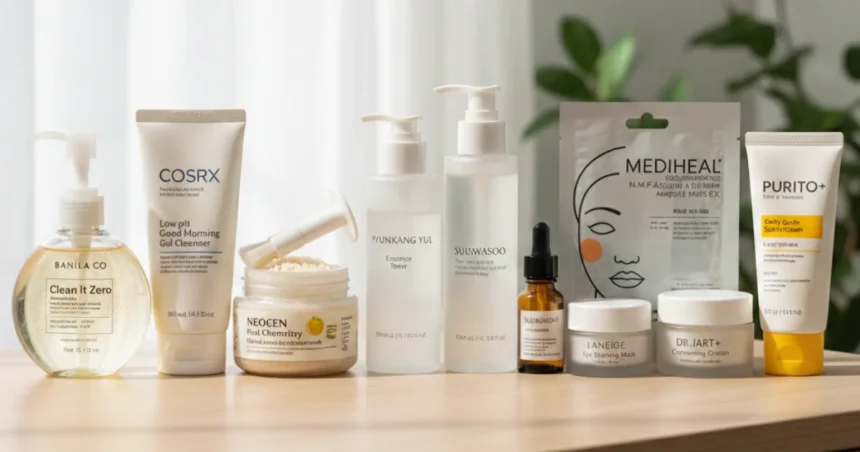
Step 1: Oil cleanser. This is the first half of double cleansing. Oil cleansers dissolve oil based impurities like sunscreen, makeup, sebum, and pollution particles that water alone can’t remove. You massage it onto dry skin, add water to emulsify into a milky texture, then rinse clean. I do this every single night without exception it’s the foundation of clean skin.
Step 2: Water-based cleanser. The second cleanse tackles water based impurities and any residue left from the oil cleanser. This double approach gives you a genuinely clean canvas for everything following. I use a gentle, low pH foam cleanser that never leaves skin tight. Together, steps one and two take maybe two minutes total.
Step 3: Exfoliator. Chemical or physical exfoliation removes dead skin cells, unclogs pores, and improves overall texture. Here’s the critical thing: this is absolutely not a daily step. I exfoliate two to three times weekly at maximum. Over-exfoliating destroyed my moisture barrier once, leaving my face red and flaky for weeks. Never making that mistake again.
Step 4: Toner. Korean toners hydrate and prep skin to absorb everything that follows. They’re watery and lightweight, nothing like the stinging alcohol based Western astringents I grew up using. I use toner morning and night it’s completely non negotiable in my routine because the hydration difference is immediate and obvious.
Step 5: Essence. Essences are lightweight hydrating treatments that deliver active ingredients deep into skin. They’re more concentrated than toners but lighter than serums, sitting perfectly between the two. I use essence most nights and skip it only when truly exhausted. Understanding what essence actually does took me a while, but now I consider it essential for that bouncy, hydrated feeling.
Step 6: Serum or ampoule. These are your targeted treatments for specific concerns vitamin C for brightening, hyaluronic acid for deep hydration, and niacinamide for pores and oil control. Ampoules are typically more concentrated versions of serums. I rotate different serums based on what my skin needs each week rather than using the same one constantly.
Step 7: Sheet mask. Sheet masks deliver concentrated doses of beneficial ingredients while you sit and relax. They’re definitely not daily essentials I use them once or twice weekly, usually on Sunday evenings when I actually have twenty minutes to spare. Emma thinks they make me look like a ghost, which honestly isn’t wrong.
Step 8: Eye cream. The delicate under-eye area may benefit from targeted treatment for dark circles, fine lines, or puffiness. I’ll be honest I use eye cream maybe three times weekly. Some people absolutely swear by it; others consider it completely unnecessary. I’m somewhere in between, using it when I remember.
Step 9: Moisturizer. This final treatment step seals everything in and keeps your skin barrier protected throughout the day or night. Completely non-negotiable for me, morning and night without fail. I adjust the weight seasonally lighter gel formulas during brutal Austin summers, richer creams when winter brings dry indoor heating.
Step 10: Sunscreen (morning) or sleeping mask (night). Mornings always mean SPF, no exceptions regardless of weather or plans. The evening version can include a sleeping mask for an extra overnight hydration boost, though I only use one a few times weekly when my skin feels particularly parched.
My actual daily routine
Here’s my reality check: I have never done all ten steps in a single routine. Not once in five years of dedicated K-beauty practice.
My actual morning routine uses four or five steps: quick water rinse or gentle cleanser, toner, lightweight moisturizer, and sunscreen. That’s it. Takes seven minutes, including brushing my teeth while products absorb.
Evening routine uses six to eight steps depending on energy levels and skin needs: oil cleanser, water based cleanser, toner, essence, targeted serum, and moisturizer. Maybe a sheet mask on relaxed weekends. Maybe a sleeping mask if skin feels extra dry from air conditioning.
The proper routine order guide explains exactly when to apply each product and the reasoning behind it. The condensed version: apply thinnest to thickest consistency, water based products before oil-based, and active treatments before heavier moisturizers.
Why so many steps exist
Korean skincare developed this multi-layered approach based on one principle: thin layers absorb better than thick ones.
Instead of slathering on one heavy cream expected to do everything, you layer multiple lightweight products. Each absorbs fully before applying the next. Your skin drinks in hydration gradually, like watering a plant slowly and steadily rather than flooding it all at once and watching water run off.
This layering philosophy also allows precise customization. Maybe your forehead needs different treatment than your cheeks. Maybe concerns shift with seasons or stress levels. Individual products give flexibility that one multitasking cream simply cannot match.
There’s also the self care element that surprised me. In Korean culture, skincare is a ritual and meditation, not a rushed chore. Those quiet minutes at the sink become decompression time, a pause between a busy day and a restful night. I didn’t appreciate this until I stopped rushing through and actually let myself enjoy the process.
Which steps matter most?
If I had to rank all ten steps by importance for most people:
Essential every day: double cleansing at night, toner, moisturizer, and sunscreen every morning. These four form the foundation everything else builds upon.
Important regularly: Essence or serum with active ingredients addressing your concerns, plus exfoliation two to three times weekly for texture and clarity.
Nice extras when possible: Sheet masks for pampering, eye cream for targeted concerns, and sleeping masks for a hydration boost.
You can absolutely build healthy, beautiful skin using just the essentials. Extras enhance results but aren’t required for success. When I’m exhausted or traveling or dealing with sick kid situations, my routine shrinks dramatically, and my skin still looks good because the foundation stays solid.
Making ten steps work for real life
The biggest mistake people make is treating this as a rigid requirement rather than a flexible framework. The 10 step routine shows you all available options. Your job is selecting which options serve your skin, schedule, and sanity.
Some nights I luxuriate through seven or eight steps because I have time and energy and my skin needs extra attention. Other nights like when Emma has nightmares or Luna needs emergency vet visits I manage cleanser, moisturizer, done. Both approaches are completely valid.
The 5 step Korean skincare routine proves conclusively that you don’t need complexity for excellent results. What you need is consistency with the basics and flexibility for everything else.
Build a routine that fits your actual life, not some aspirational fantasy version. Korean skincare taught me that caring for skin doesn’t require complexity or hours of time. Ten steps gave me a comprehensive map of possibilities. But I draw my own route through it daily, and so should you.