Nobody gets excited about glycerin.
Scroll through any skincare forum and you’ll find endless discussions about hyaluronic acid, debates about snail mucin, deep dives into fermented ingredients. But glycerin? It barely gets a mention. It’s the ingredient equivalent of beige, reliable, functional, completely unglamorous.
I ignored glycerin for years too. When I first got into K-beauty, I was chasing the exciting stuff. Ingredients with interesting origin stories and impressive-sounding benefits. Glycerin was just… there. On every ingredient list, sure, but not anything I thought about.
Then I started paying attention to what was actually in my favorite products. The toner that made my skin feel like velvet? Glycerin in the first five ingredients. The moisturizer I’d repurchased four times? Glycerin, right near the top. The essence that transformed my dehydrated skin? You guessed it.
Glycerin has been doing the heavy lifting in my routine all along. I just never gave it credit.
What is glycerin and how does it hydrate?
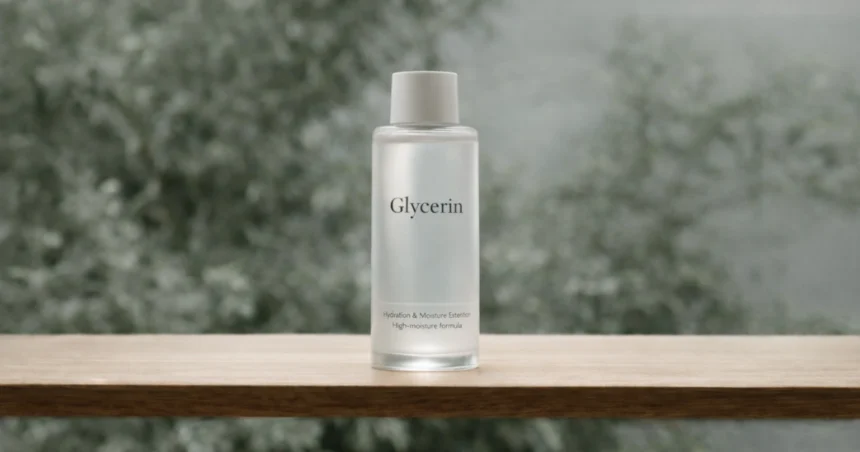
Glycerin (also called glycerol) is a humectant, the same category as hyaluronic acid and beta-glucan. Humectants attract water molecules from the environment and deeper skin layers, pulling moisture to the surface where you need it.
Chemically, glycerin is a simple sugar alcohol used in skincare for over two centuries. It occurs naturally in your skin as part of your natural moisturizing factor (NMF), the collection of compounds keeping skin hydrated.
What makes glycerin special isn’t one dramatic benefit. It’s the combination of effectiveness, gentleness, and versatility. Glycerin draws moisture to skin, strengthens the barrier by filling gaps between cells, improves texture with consistent use, enhances penetration of other ingredients, and rarely causes irritation, suitable for virtually every skin type.
The reason glycerin doesn’t get hyaluronic acid’s hype is partly because it’s not new or trendy. It’s been around forever. But longevity in skincare usually means something works, ingredients that don’t deliver results don’t stick around for 200 years.
Why glycerin is in almost every K-beauty product
Once I started looking, I couldn’t unsee it. Glycerin is everywhere in Korean skincare.
Check your hydrating toner’s ingredient list. Glycerin. Your favorite essence. Glycerin. That moisturizer you love. Almost certainly glycerin, probably in the top five ingredients.
Korean formulators rely on glycerin for several reasons.
It’s incredibly effective. Studies consistently show glycerin is one of the most effective humectants available. Some research suggests it may hydrate better than hyaluronic acid in certain conditions, particularly at lower humidity. It pulls moisture efficiently without the environmental dependence that makes HA tricky in dry climates.
It’s affordable. Glycerin is inexpensive to source and formulate with, meaning brands can use it generously without raising prices. This aligns with K-beauty’s philosophy of accessible, effective skincare for everyone.
It plays well with everything. Glycerin doesn’t conflict with acids, retinoids, vitamin C, or other actives. It actually helps other ingredients work better by improving absorption.
It’s stable. Unlike vitamin C that degrades quickly, glycerin stays effective over time. It doesn’t oxidize, doesn’t need special storage, and maintains benefits throughout a product’s shelf life.
The K-beauty approach has always been about building routines with multiple gentle, effective layers. Glycerin fits perfectly, a team player making everything else work better.
Glycerin vs hyaluronic acid
People wonder whether they need both glycerin and hyaluronic acid, or if one can replace the other. They do similar things slightly differently, and most people benefit from having both.
Hyaluronic acid is the flashier hydrator. It has impressive water-binding capacity, gives immediate plumping, and works beautifully in humid conditions. But it can be finicky, needs correct application and may underperform when humidity is low.
Glycerin is the steady workhorse. It might not give the same instant “wow” as HA, but delivers consistent hydration regardless of environment. It’s also more affordable, meaning products can contain higher concentrations.
Where hyaluronic acid pulls moisture primarily from surrounding air, glycerin pulls from air and deeper skin layers while reinforcing your barrier to prevent loss. It’s less dependent on environmental conditions.
Most well-formulated K-beauty products include both. They complement each other, HA for immediate plumping, glycerin for sustained hydration and barrier support. If I had to pick only one for a dry climate, I’d lean toward glycerin for reliability.
Can glycerin cause breakouts?
This question appears constantly. When an ingredient is in literally everything and you’re breaking out, glycerin seems like an obvious suspect.
The short answer: glycerin is non-comedogenic and very unlikely to cause breakouts on its own.
Glycerin rates 0 on the comedogenicity scale, essentially no pore-clogging potential. Dermatologists routinely recommend glycerin-containing products for breakout-prone skin because it’s so gentle.
However, a few situations might make glycerin seem problematic:
The other ingredients. If a product contains glycerin and breaks you out, it’s almost certainly something else in the formula. Check for coconut derivatives, certain plant oils, or other ingredients your skin dislikes.
Too much concentration. In very high amounts, glycerin can feel sticky on some skin types. This doesn’t cause breakouts but might feel uncomfortable. Well-formulated products balance glycerin appropriately.
Humidity factors. Because glycerin attracts moisture, in very humid conditions it might feel like skin is holding onto sweat. Not a direct breakout cause, but could contribute if you’re not cleansing properly afterward.
I’ve never had glycerin cause problems, and I have combination skin that leans oily. If you’re convinced glycerin is breaking you out, try eliminating it temporarily, but look at other ingredients first.
How to know if a product has enough glycerin
Since glycerin is so common, almost any K-beauty product contains it. The question is whether it contains enough to make meaningful difference.
Ingredients are listed in descending order of concentration. For significant hydrating effects, you want glycerin in the top five to seven ingredients. If buried way down the list, it’s likely present in such small amounts that it’s more texture enhancer than hydration source.
In my favorite hydrating products, glycerin typically appears second or third, right after water. That tells me the brand is using it seriously.
The most effective concentration in research is between 3-10%, though products don’t usually disclose exact percentages. Position on the ingredient list is your best clue.
The glycerin-free trend
Every now and then, I see people advocating for “glycerin-free” skincare, claiming it causes dehydration or congestion. This trend contradicts both research and my experience.
The anti-glycerin argument stems from misunderstanding how humectants work. Yes, glycerin pulls moisture from wherever it can find it, theoretically from deeper skin layers. But glycerin also significantly reduces transepidermal water loss, meaning skin loses less moisture overall. The net effect is positive hydration, not dehydration.
Unless you have genuine sensitivity to glycerin (extremely rare), there’s no evidence-based reason to avoid it. You’d be eliminating one of the most effective, gentle, well-researched hydrating ingredients available.
If you’ve tried glycerin-heavy products and didn’t like the texture, that’s valid, preferences are personal. But that’s different from glycerin being bad for your skin.
The quiet hero
Glycerin will probably never trend on social media. It doesn’t have a fascinating origin story like snail mucin or a cult following like vitamin C. It just works, quietly and consistently, in nearly every product you own.
There’s something reassuring about that. In a world of constantly rotating “miracle” ingredients, glycerin has been here all along, doing its job without demanding attention. It hydrates. It protects. It plays well with everything else.
Next time you’re reading an ingredient list, give glycerin a little mental nod of appreciation. It’s been taking care of your skin this whole time, you just might not have noticed.