The first time I saw a full Korean skincare routine, I was overwhelmed.
Toner, essence, serum, ampoule, emulsion, cream, how could anyone need that many products? It seemed excessive, maybe even a marketing ploy to sell more stuff. My American skincare upbringing had taught me simple was better. Cleanser, moisturizer, done.
But my skin was perpetually dehydrated. That tight feeling after cleansing. Fine lines that appeared when I was tired or stressed. Makeup that clung to dry patches no matter how much moisturizer I slathered on. I was doing what I’d always been told to do, and it wasn’t working.
So I tried the layers.
Not the full 10-step routine right away, that felt too intimidating. Just a hydrating toner before my moisturizer. Then an essence. Then a serum. Slowly building up, paying attention to how my skin responded.
The difference was remarkable. My skin didn’t just feel more hydrated, it looked different. Plumper. Dewier. That coveted bouncy quality I’d seen in K-beauty ads but assumed was genetics or good lighting. Turns out, it was layers. Thin, watery layers of hydration, stacked strategically and sealed in properly.
Now layering is second nature. And I’m convinced it’s the single most important technique I’ve learned from Korean skincare.
Why layering matters
The philosophy behind Korean skincare layering is fundamentally different from the Western approach.
Western skincare traditionally focuses on one or two products doing heavy lifting. A thick, rich moisturizer applied once is supposed to handle all your hydration needs. The assumption is that more product equals more moisture.
Korean skincare flips this. Instead of one heavy layer, you apply multiple thin layers that build on each other. Each layer adds hydration while helping the next layer absorb better. The result is deep, lasting moisture that a single product can’t achieve alone.
Think of it like watering a plant. If you dump a huge amount of water all at once, most of it runs off or sits on top of the soil. The roots don’t absorb it efficiently. But if you water slowly, in smaller amounts over time, the soil has a chance to absorb each addition. The water goes deeper and actually reaches where it’s needed.
Your skin works similarly. A thick cream sitting on top of dry skin can only penetrate so much. But thin, watery products absorb quickly and prep your skin to receive the next layer. By the time you apply your cream, your skin has already received multiple doses of hydration, and it’s primed to absorb even more.
This is why someone using five lightweight products might have better-hydrated skin than someone using one expensive heavy cream. It’s not about the products. It’s about the technique.
The thinnest-to-thickest rule explained
The core principle of Korean skincare layering is simple: apply products from thinnest to thickest consistency.
Watery products go first. Creamy products go last. Everything else falls somewhere in between based on texture.
The science behind this makes sense. Thin, water-based products have smaller molecules that can penetrate your skin more easily. If you apply a heavy cream first, it creates a barrier that prevents lighter products from getting through. You’re essentially blocking your expensive serum from doing its job.
By going thinnest to thickest, each layer can penetrate before the next layer goes on top. Your watery toner absorbs, then your essence absorbs, then your serum absorbs, and finally, your cream seals everything in place.
A typical layering order looks like this:
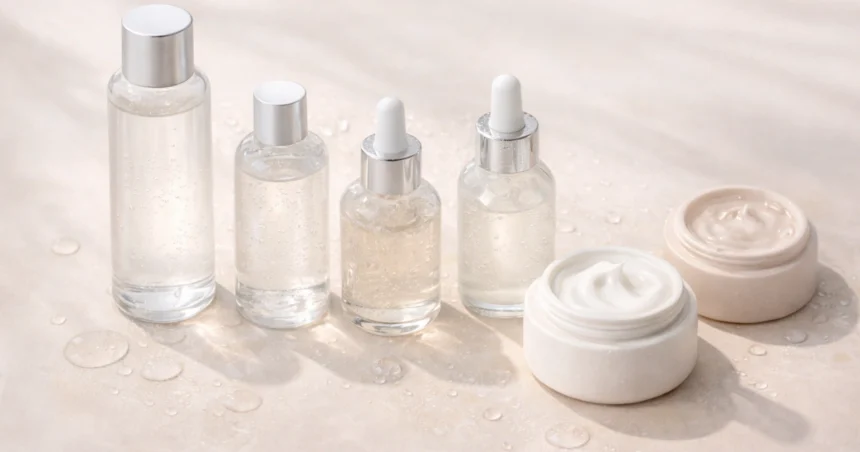
- Toner (most watery)
- Essence (slightly thicker than toner, still very fluid)
- Serum or ampoule (more concentrated, gel-like or slightly viscous)
- Emulsion (lightweight lotion, optional step)
- Moisturizer/cream (thickest consistency)
- Facial oil (if using, oils are occlusive and go last)
- Sleeping pack (nighttime only, very last step)
You don’t need all these steps. Most days, I use four or five products total. The point isn’t to maximize the number of layers, it’s to apply whatever products you do use in the right order.
My actual layering order (morning routine)
Mornings are rushed in my house. Two kids to get ready, Mochi demanding her walk, coffee to consume before I’m functional. My morning skincare needs to be efficient.
Step 1: Gentle cleanser or water rinse. I don’t always use cleanser in the morning since my skin isn’t dirty from sleeping. Sometimes just a splash of lukewarm water is enough.
Step 2: Hydrating toner on damp skin. This is key, I apply toner while my face is still slightly wet from rinsing. The dampness helps the toner spread and gives humectant ingredients like hyaluronic acid moisture to work with. I pat it in with my palms, no cotton pad.
Step 3: Essence or lightweight serum. My morning essence is always hydrating, nothing too active. I want to plump and prep my skin, not treat it aggressively before facing the day. A few drops, patted gently.
Step 4: Moisturizer. In the morning, I use something lightweight, a gel cream or light lotion that absorbs quickly. Heavy creams can interfere with sunscreen and makeup.
Step 5: Sunscreen. Non-negotiable. Every single day. I wait about a minute after moisturizer to let it absorb, then apply SPF generously.
That’s five steps, maybe three minutes total once you’re used to it. No elaborate rituals, just efficient layering.
My actual layering order (evening routine)
Evenings are when I invest more time and use more layers. The kids are (finally) asleep, Mochi is snoring on her bed, and I have a few minutes to actually enjoy my routine.
Step 1: Oil cleanser or cleansing balm. The first step of double cleansing to remove sunscreen and any makeup. I massage it onto dry skin, then rinse.
Step 2: Water-based cleanser. A gentle, pH-balanced cleanser to remove any residue. My skin should feel clean but not tight.
Step 3: Toner on damp skin. Same as morning, applied while my face is still wet from cleansing. Sometimes I do two or three layers of toner if my skin is feeling particularly parched (the “7-skin method” in miniature).
Step 4: Essence. A hydrating essence to start building moisture. Patted in gently.
Step 5: Treatment serum or ampoule. This is where I use any actives I’m incorporating, vitamin C, niacinamide, whatever I’m focusing on. If my skin is feeling sensitive, I skip actives and just use another hydrating serum.
Step 6: Eye cream. Gently patted around the orbital bone. Not too close to my actual eyes.
Step 7: Moisturizer. At night, I use something richer than my morning cream. My skin has hours to absorb it without worrying about makeup or shine.
Step 8: Facial oil (optional). If I’m using squalane or another face oil, it goes here, after moisturizer or mixed into it.
Step 9: Sleeping pack (a few times per week). Not every night, but when I want extra hydration. This is the final seal that locks everything in.
Eight or nine steps sounds like a lot, but most of them take seconds. The whole routine is maybe ten minutes, and honestly, those ten minutes of patting products into my skin while the house is quiet have become something I look forward to.
Patting technique: how and why
You’ll notice I keep saying “pat” instead of “rub.” This is intentional.
Korean skincare emphasizes patting or pressing products into your skin rather than rubbing them across your face. There are a few reasons for this:
Less tugging on skin. Rubbing pulls at your skin, especially the delicate areas around your eyes. Over time, this can contribute to loss of elasticity. Patting is gentler.
Better absorption. The pressing motion seems to help products absorb more effectively. I don’t have scientific proof of this, but my experience suggests patted-in products feel like they penetrate better than rubbed-in ones.
More product stays on your face. When you rub, some product ends up on your palms or gets pushed around instead of absorbing. Patting deposits product and leaves it there.
It’s more relaxing. There’s something meditative about gently patting your face. It feels like care rather than a chore.
To pat correctly: dispense product onto your fingertips or palms, then use gentle pressing motions to apply it all over your face. Work from the center outward. Use your ring fingers around your eyes since they apply the least pressure. Don’t slap your face hard, gentle, repeated pressing is the goal.
Do you need to wait between layers?
This question comes up constantly. Do you need to wait for each layer to absorb before applying the next one?
The honest answer: it depends, but usually not long.
For most hydrating layers (toner, essence, serum), you just need to wait until the product feels mostly absorbed, maybe 20-30 seconds. Your skin shouldn’t be dripping wet when you apply the next layer, but it doesn’t need to be completely dry either. A slight tackiness is fine and actually helps the next layer adhere.
For certain active ingredients, waiting matters more. If you’re using vitamin C at a low pH, waiting a few minutes before your next step can improve its effectiveness. Same with certain acids. But for purely hydrating products, no extended waiting needed.
My rule of thumb: if the product I just applied has absorbed enough that my skin feels tacky rather than wet, I move on. This keeps my routine efficient without rushing so much that products pile up on top of each other.
Signs you’re layering too much
More layers isn’t always better. Sometimes I get overenthusiastic and my skin lets me know.
Pilling. If products ball up and roll off your skin when you try to apply the next layer, you’ve used too much of something or you’re not letting layers absorb enough. Dial back the amount or wait a bit longer between steps.
Greasy or heavy feeling. Properly layered products should absorb and leave skin feeling hydrated but not greasy. If you feel like you’re wearing a mask of product, simplify.
Breakouts in unusual places. Sometimes over-layering can lead to congestion, especially if you’re using too many heavy products. If you notice new breakouts after adding layers, scale back.
Products not performing. If your expensive serum doesn’t seem to be doing anything, it might be getting blocked by layers applied before or after. Reassess your order.
The goal is hydrated, healthy skin, not the maximum possible number of products. Listen to your face. Some days it wants all the layers. Some days it needs less.
Making layering work for you
Korean skincare layering changed my skin more than any single product ever has. The technique matters as much as what you’re using.
Start simple if this is new to you. Add one layer, a hydrating toner before your moisturizer, and see how your skin responds. Build from there if you want more. There’s no rule that says you need seven steps or ten steps or any specific number. You need as many layers as your skin benefits from.
The thinnest-to-thickest principle, the patting technique, the damp skin application, these small adjustments compound into real results. Your products work better. Your skin holds onto moisture longer. That bouncy, hydrated look stops being aspirational and starts being attainable.
It’s not about doing more. It’s about doing it right.