My skin looked fine on the surface, but something was off.
No matter how much moisturizer I applied, that tight feeling after cleansing never fully went away. Fine lines appeared and disappeared depending on the day. My foundation clung to invisible dry patches. I was doing everything the magazines told me to do, cleanser, moisturizer, done, and my skin still seemed to be asking for something more.
Korean skincare taught me what that something was: hydration. Real, layered, intentional hydration.
The K-beauty approach to hydrating skin is fundamentally different from what I grew up with. Instead of one heavy cream doing all the work, Korean skincare builds moisture through multiple lightweight layers, each one drawing water into your skin and helping it stay there. The ingredients are gentle but effective. The philosophy prioritizes giving skin what it needs rather than stripping it and starting over.
- The Korean philosophy of hydration
- Hydration vs moisture: why the difference matters
- Hyaluronic acid: the most famous hydrating ingredient
- Beyond HA: humectants that deserve more attention
- Ceramides and barrier health
- Lightweight oils that lock in hydration
- Supporting ingredients that boost results
- The art of layering hydrating products
- Fixing dehydrated skin with the right ingredients
- Reading labels and understanding ingredient forms
- Frequently asked questions
This guide covers everything I’ve learned about hydrating ingredients in Korean skincare, the humectants that attract water, the emollients that soften, the occlusives that seal everything in, and how they all work together to create that bouncy, dewy, healthy look that made me fall in love with K-beauty in the first place.
The Korean philosophy of hydration
Korean skincare approaches hydration differently than Western routines, and understanding this philosophy changed how I think about moisturizing entirely.
The traditional Western approach treats hydration as a single step. You cleanse, you apply a moisturizer, you’re done. The assumption is that one product, usually a cream, handles all your skin’s moisture needs. If your skin is dry, you use a heavier cream. If it’s oily, you use a lighter one. Simple.
K-beauty flips this thinking. Instead of relying on one product to do everything, Korean skincare builds hydration through multiple lightweight layers. Toner adds the first wave of moisture. Essence adds more. Serum adds targeted hydration. Moisturizer seals it all in. Each layer serves a purpose, and together they deliver deeper, longer-lasting hydration than any single product could achieve alone.
This layered approach works because of how skin actually absorbs moisture. Thin, watery products penetrate more easily than thick creams. By applying hydration in stages, starting with the lightest textures and working toward heavier ones, you’re giving each layer a chance to absorb before the next one goes on top. Your skin receives moisture at multiple levels, not just on the surface.
The ingredients matter too. K-beauty formulations emphasize humectants, molecules that attract water and bind it to your skin. Hyaluronic acid, glycerin, beta-glucan, and other water-loving ingredients appear throughout Korean products, from the first toner step to the final cream.
This philosophy extends beyond product choice to application technique. Patting instead of rubbing. Applying to damp skin. Giving layers time to absorb. These small details compound into noticeable results.
If you’re used to one-and-done moisturizing, the Korean approach might seem complicated at first. But once you experience truly hydrated skin, plump, bouncy, comfortable all day, the extra steps feel worth it.
Hydration vs moisture: why the difference matters
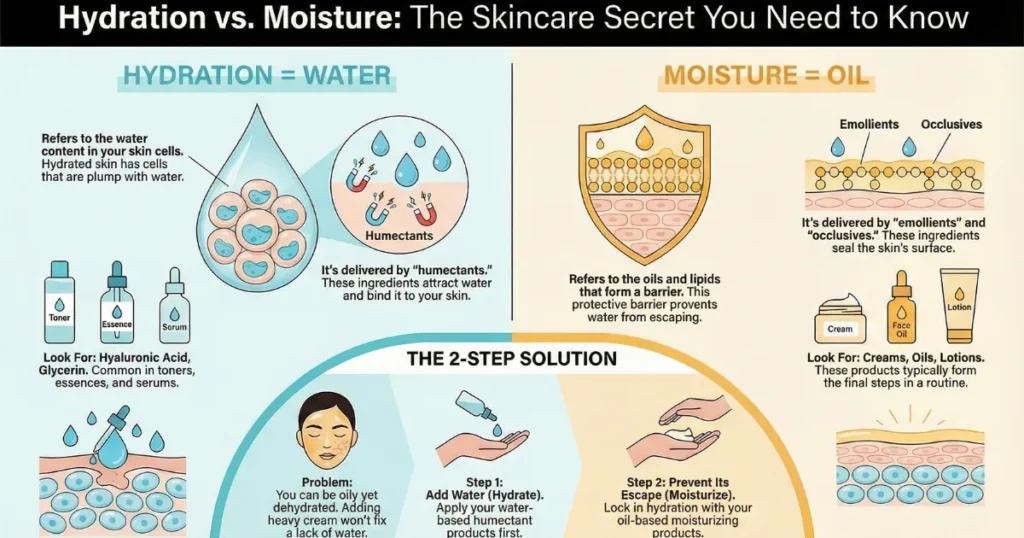
One of the most important things Korean skincare taught me is that hydration and moisture aren’t the same thing. I used to use these words interchangeably, assuming they meant identical concepts. They don’t, and understanding the distinction transformed my skincare results.
Hydration refers to water content in your skin. When your skin is hydrated, the cells are plump with water. Hydration comes from humectants, ingredients like hyaluronic acid and glycerin that attract water molecules and bind them to your skin. These ingredients pull moisture from the environment and from deeper skin layers, delivering it where you need it most.
Moisture refers to oils and lipids that prevent water from escaping. Moisturizing ingredients create a protective barrier on your skin’s surface, sealing in the hydration you’ve added and preventing evaporation. Emollients soften and smooth, while occlusives form a physical barrier against water loss.
Here’s why this matters: you can have oily skin that’s still dehydrated, and you can have dry skin that’s not properly moisturized. They’re different problems requiring different solutions.
If your skin lacks water (dehydration), piling on heavy creams won’t fix it. You need humectants first, ingredients that actually add water to your skin. Then you need something to lock that water in place.
If your skin lacks oil (dryness), humectants alone won’t solve the problem. Water will evaporate right back out without a protective lipid layer to hold it there.
Most people need both. The K-beauty approach addresses this by layering humectants first (toners, essences, serums packed with water-attracting ingredients) and following with moisturizers and oils that seal everything in. It’s a two-part system: add water, then prevent its escape.
This is also why some people find hyaluronic acid doesn’t work for them. If you apply a humectant without sealing it properly, the water it attracted can evaporate, potentially leaving skin drier than before. Understanding the hydration-moisture relationship helps you use ingredients correctly.
Hyaluronic acid: the most famous hydrating ingredient
No ingredient dominates the hydration conversation quite like hyaluronic acid. It’s the star of countless K-beauty products, the ingredient brands plaster across packaging, and probably the first humectant most people encounter when exploring Korean skincare.
The hype exists for good reason. Hyaluronic acid is a molecule your body produces naturally, it’s found in your skin, joints, and eyes. Its claim to fame is holding up to 1,000 times its weight in water, which translates to serious plumping and hydrating power when applied topically. Those fine dehydration lines that appear when your skin is parched? HA can make them virtually disappear.
But hyaluronic acid is more nuanced than the marketing suggests.
First, there’s the question of molecular weight. HA comes in different sizes, and size determines how the ingredient behaves on your skin. Larger molecules sit on the surface, creating a moisture-locking film and giving you that immediate plump. Smaller molecules can penetrate deeper, delivering hydration below the surface. Many K-beauty products combine multiple molecular weights to address hydration at every level.
Then there’s application technique, which matters more for hyaluronic acid than almost any other ingredient. HA is a humectant, it attracts water from wherever it can find it. Apply it to damp skin in a reasonably humid environment, and it pulls that moisture to your face beautifully. Apply it to dry skin in an arid climate, and it may pull water from deeper layers of your own skin instead, potentially leaving you drier than before.
This is why some people swear by hyaluronic acid while others feel it doesn’t work for them. The ingredient itself is effective; the results depend heavily on how you use it.
The key principles: apply HA to skin that’s still slightly wet from cleansing or toning, layer it with other hydrating products, and always seal it with a moisturizer or occlusive to prevent the water it attracted from evaporating back out.
Beyond HA: humectants that deserve more attention
Hyaluronic acid gets all the attention, but it’s far from the only humectant worth knowing. Korean skincare formulations rely on a whole family of water-attracting ingredients, many of which outperform HA in specific situations.
Glycerin is the unsung hero of hydrating products. It appears in nearly every well-formulated K-beauty toner, serum, and moisturizer, often in the top five ingredients, yet rarely gets mentioned in skincare conversations. Glycerin is affordable, stable, effective, and gentle on virtually all skin types. It doesn’t have hyaluronic acid’s glamour, but it’s been quietly hydrating skin for over two centuries. There’s a reason formulators keep reaching for it.
Beta-glucan deserves far more recognition than it receives. This polysaccharide, derived from oats, mushrooms, or yeast, holds moisture impressively while adding soothing, anti-inflammatory benefits that HA doesn’t provide. For anyone with sensitive or reactive skin, beta-glucan delivers hydration without any risk of irritation. It also performs more reliably in dry climates because it doesn’t depend as heavily on environmental humidity.
Polyglutamic acid is the newer player generating buzz in K-beauty circles. Derived from fermented soybeans, PGA can hold four to five times more water than hyaluronic acid. It creates a smoothing film on the skin’s surface that fills in fine lines visibly while preventing moisture loss. The texture is different, thicker and slightly tacky, but the results are impressive.
Panthenol, or provitamin B5, works as both a humectant and a soothing agent. It attracts moisture while supporting skin healing and barrier repair. You’ll find it in products across every category, quietly contributing to hydration and comfort without demanding attention.
The best hydrating routines don’t rely on a single humectant. They combine several, letting each ingredient contribute its strengths. Glycerin provides reliable base hydration, hyaluronic acid adds plumping power, beta-glucan soothes and protects, and panthenol supports overall skin health.
Ceramides and barrier health
All the hydrating ingredients in the world won’t help if your skin can’t hold onto moisture. This is where ceramides become essential, they’re not humectants that add water, but lipids that keep water from escaping.
Your skin barrier is the outermost layer of your skin, responsible for two critical jobs: keeping moisture in and keeping irritants out. When this barrier is healthy, your skin stays hydrated, comfortable, and resilient. When it’s compromised, water evaporates rapidly, irritants penetrate easily, and your skin becomes reactive, dry, and uncomfortable no matter how many hydrating serums you apply.
Ceramides are a key structural component of this barrier. Think of your skin barrier like a brick wall: the skin cells are the bricks, and ceramides (along with cholesterol and fatty acids) are the mortar holding everything together. When you have adequate ceramides, the mortar is strong and intact. When ceramides are depleted, gaps form, and your barrier starts to fail.
Several factors deplete ceramides. Age is one, your body produces fewer ceramides as you get older, which partly explains why mature skin tends toward dryness. Over-exfoliation strips ceramides faster than your skin can replace them. Harsh cleansers, extreme weather, and environmental stressors all take their toll.
The good news is that topical ceramides actually work. Unlike some ingredients that sound impressive but can’t penetrate meaningfully, ceramide-containing products can genuinely help replenish what your skin has lost. Research supports their effectiveness for barrier repair and moisture retention.
In a well-designed hydrating routine, ceramides complement humectants perfectly. Hyaluronic acid, glycerin, and other humectants attract water to your skin. Ceramides help ensure that water stays put by maintaining barrier integrity. Without adequate ceramides, you’re essentially trying to fill a leaky container, the hydration goes in, but it doesn’t stick around.
If your skin feels perpetually dehydrated despite using hydrating products, or if you’ve noticed increased sensitivity and reactivity, compromised barrier function might be the underlying issue.
Lightweight oils that lock in hydration
For years, I avoided face oils entirely. Growing up with combination skin and occasional breakouts, I was convinced oils would make everything worse. The idea of deliberately putting oil on my face seemed counterproductive, wouldn’t it just create more shine and clog more pores?
Korean skincare changed my perspective by introducing me to oils that behave nothing like I expected.
The role of oils in a hydrating routine is sealing. After you’ve applied your humectants, the toners, essences, and serums filled with water-attracting ingredients, you need something to lock that moisture in place. Without an occlusive layer, the water you just added can evaporate right back into the air. Oils create a protective barrier that prevents this loss.
But not all oils are created equal. Heavy, comedogenic oils can indeed clog pores and cause breakouts. The key is choosing oils that seal effectively without creating problems.
Squalane is the standout option for most skin types. It’s derived from olives or sugarcane and is remarkably similar to sebum your skin produces naturally. This similarity means squalane absorbs quickly, feels lightweight rather than greasy, and rarely causes congestion. Even oily and acne-prone skin types often tolerate it beautifully.
What makes squalane particularly appealing is its texture. Unlike heavy plant oils that sit on the skin’s surface, squalane sinks in almost immediately. You get the sealing benefits without the uncomfortable, shiny residue. It layers well under makeup and doesn’t interfere with other products in your routine.
Squalane also offers flexibility in how you use it. You can apply it as the final step in your routine, mix a few drops into your moisturizer for extra protection, or use it alone on minimalist skincare days. It adapts to what your routine needs.
For anyone who’s been avoiding oils based on outdated assumptions, lightweight options like squalane offer a way to complete your hydrating routine without the downsides you might fear. The difference between a routine that adds hydration and one that adds and keeps hydration often comes down to this final sealing step.
Supporting ingredients that boost results
The star ingredients get all the attention, hyaluronic acid, ceramides, squalane. But some of the most effective hydrating products succeed because of supporting ingredients that work quietly in the background, enhancing results without demanding recognition.
Panthenol exemplifies this perfectly. Also known as provitamin B5, panthenol appears in countless K-beauty products across every category. Check your favorite toner, serum, or moisturizer, there’s a good chance panthenol is on the ingredient list, probably somewhere in the middle, doing its job without fanfare.
What makes panthenol valuable is its versatility. It functions as a humectant, drawing moisture to your skin. It acts as an emollient, softening and smoothing the skin’s surface. It supports barrier function, helping your skin protect itself. And it has genuine soothing properties, calming irritation and supporting the healing process.
This combination makes panthenol especially useful when your skin is stressed or compromised. If you’ve overdone it with actives, if weather changes have left your face reactive, if you’re recovering from a procedure or a breakout, panthenol-containing products provide hydration without any risk of making things worse. It’s one of the gentlest, most universally tolerated ingredients in skincare.
Allantoin is another quiet contributor worth knowing. It softens skin, promotes healing, and soothes irritation. Like panthenol, it appears in supporting roles across product categories, contributing to overall comfort and efficacy.
Trehalose, a sugar-based humectant, protects skin cells from environmental stress while attracting moisture. It’s less famous than glycerin or hyaluronic acid but increasingly appreciated by formulators for its dual hydrating and protective properties.
These supporting ingredients rarely appear as headline acts. You won’t see products marketed around allantoin or trehalose the way you see hyaluronic acid serums. But their presence often separates mediocre formulations from excellent ones. When reading ingredient lists, noticing these supporting players can tell you a lot about a product’s overall quality and thoughtfulness.
The art of layering hydrating products
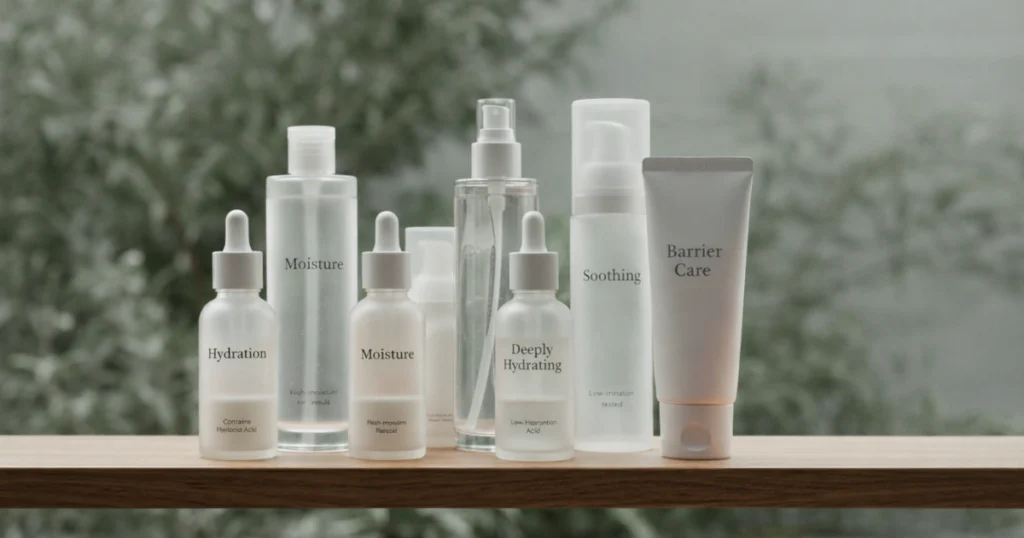
Having great hydrating ingredients matters, but how you apply them matters just as much. This is where Korean skincare’s layering technique transforms good products into exceptional results.
The core principle is simple: apply products from thinnest to thickest consistency. Watery products go first, creamy products go last, and everything else falls somewhere in between based on texture.
This order exists for practical reasons. Thin, water-based products have smaller molecules that penetrate your skin more easily. If you apply a heavy cream first, it creates a barrier that prevents lighter products from getting through. By working from thinnest to thickest, each layer has a chance to absorb before the next one goes on top. Your expensive serum actually reaches your skin instead of sitting on top of your moisturizer, wasted.
A typical layering sequence might look like this: hydrating toner, essence, serum, moisturizer, facial oil. You don’t need all these steps, some days I use three products, some days I use six, but whatever products you do use should follow the consistency rule.
Application technique matters too. Korean skincare emphasizes patting or pressing products into your skin rather than rubbing them across your face. This gentle pressing motion helps products absorb without tugging at delicate skin. It feels more like care than chore.
Timing plays a role as well. You don’t need extended waits between most hydrating layers, just enough time for each product to feel mostly absorbed before applying the next. That slight tackiness you feel after a serum? That’s actually helpful; it means the product is still active on your skin and can help the next layer adhere.
The damp skin principle applies throughout. Starting your routine on slightly wet skin gives humectants immediate moisture to work with. Many people pat toner onto skin that’s still damp from cleansing, building hydration from the very first step.
These details might seem minor, but they compound into visible differences. The same products applied carelessly versus applied thoughtfully can yield surprisingly different results.
Fixing dehydrated skin with the right ingredients
Dehydration is one of the most common skin concerns I hear about, partly because it’s so often misdiagnosed. People assume they have dry skin when they actually have dehydrated skin, and the distinction determines which solutions will actually work.
Dry skin is a skin type determined by genetics. It means your skin doesn’t produce enough oil. Dehydrated skin is a temporary condition that can affect any skin type, including oily skin. It means your skin lacks water. You can have an oily T-zone and still be dehydrated, in fact, dehydration sometimes triggers excess oil production as your skin tries to compensate for what it’s missing.
The signs of dehydration are distinctive once you know what to look for. Tightness after cleansing that moisturizer doesn’t fully resolve. Fine lines that appear and disappear depending on the day, visible in the morning, gone after skincare, back again by evening. Dull, flat-looking skin that lacks radiance even when you’re well-rested. Foundation that clings to invisible dry patches. Skin that seems to drink up products instantly, desperate for moisture.
If any of this sounds familiar, the solution isn’t heavier creams. It’s humectants, ingredients that actually attract water to your skin and help it stay there.
The good news about dehydration is that it responds relatively quickly to proper treatment. Within days of using the right ingredients correctly, your skin should start feeling more comfortable. Within a couple of weeks, visible improvement in plumpness and texture. Within a month, significant transformation if you stay consistent.
The approach combines multiple strategies: humectants to add water, barrier-supporting ingredients to prevent loss, and gentle formulations that don’t further compromise your skin. Avoiding certain ingredients matters too, harsh alcohols, stripping cleansers, and over-exfoliation can all worsen dehydration while you’re trying to fix it.
Building a dehydration-rescue routine isn’t complicated, but it does require understanding which ingredients actually address the problem versus which ones just mask symptoms temporarily.
Reading labels and understanding ingredient forms
Knowing which hydrating ingredients work is only half the equation. You also need to recognize them when you’re shopping, and ingredient labels can be surprisingly confusing.
Take hyaluronic acid, the most famous humectant in skincare. You might scan an ingredient list looking for “hyaluronic acid” and not find it, concluding the product doesn’t contain HA. But it might be listed as “sodium hyaluronate” instead, the salt form of hyaluronic acid that most products actually use. Same basic ingredient, different name on the label.
This kind of variation is common. Ingredients appear under their scientific names, their common names, or variations that reflect different processing methods. Without knowing what to look for, you can miss ingredients you want or fail to recognize ingredients you’re trying to avoid.
Understanding ingredient forms also helps you evaluate product quality. Ingredients are listed in descending order of concentration, the higher something appears on the list, the more of it the product contains. If hyaluronic acid is the second ingredient, you’re getting a meaningful amount. If it’s buried near the bottom after fragrance and preservatives, it’s likely present in trace quantities, more for marketing than efficacy.
Different forms of the same ingredient can also perform differently. Sodium hyaluronate has smaller molecules than pure hyaluronic acid, potentially offering better penetration. Hydrolyzed hyaluronic acid is broken into even smaller fragments for deeper delivery. Products advertising “multi-molecular” or “5 types of HA” are combining these forms to hydrate at multiple skin levels.
Similar variations exist for other ingredients. You might see “panthenol” or “dexpanthenol” or “provitamin B5”, all referring to the same thing. Beta-glucan might appear as “oat beta-glucan” or “saccharomyces beta-glucan” depending on its source.
Learning to decode these labels transforms you from a passive consumer into an informed one. You can evaluate whether products actually contain what they claim, compare formulations meaningfully, and make smarter purchasing decisions based on what’s really inside the bottle rather than what’s written on the front.
Frequently asked questions
What is the difference between hydrating and moisturizing? Hydrating adds water to your skin using humectants like hyaluronic acid and glycerin. Moisturizing prevents water loss using oils and occlusives that create a protective barrier. Most skin needs both, humectants to deliver moisture, then emollients and occlusives to seal it in place.
Can oily skin be dehydrated? Absolutely. Oily skin produces excess sebum, but sebum and hydration are different things. Your skin can overproduce oil while simultaneously lacking water. In fact, dehydration sometimes triggers more oil production as your skin tries to compensate. Properly hydrating oily skin often helps regulate oil production.
Why does hyaluronic acid make my skin feel drier? This usually happens when HA is applied to dry skin or not sealed properly. Hyaluronic acid attracts moisture from wherever it can find it, ideally from the air, but potentially from deeper skin layers if no other moisture is available. Always apply HA to damp skin and follow with a moisturizer to lock hydration in.
How many hydrating products do I actually need? There’s no required number. Some people thrive with three products; others prefer six or more layers. Start simple, a hydrating toner and a good moisturizer, and add products if your skin wants more. The layering technique matters more than the number of steps.
What’s the best hydrating ingredient for sensitive skin? Beta-glucan and panthenol are excellent choices for sensitive skin because they hydrate while also soothing inflammation. They’re gentle, rarely cause reactions, and support barrier health. Glycerin is another safe, well-tolerated option for reactive complexions.
Should I use hydrating products morning and night? Yes, hydration benefits from consistency. Your skin loses moisture throughout the day and overnight, so replenishing it twice daily helps maintain healthy hydration levels. You might use lighter products in the morning and richer ones at night, but the hydrating principle applies to both routines.
How long does it take to see results from hydrating ingredients? Dehydrated skin often shows improvement within days of consistent use, reduced tightness, more comfort, better texture. Visible plumping and that dewy K-beauty glow typically develop within two to four weeks. Long-term barrier health improvements continue building over months of regular use.
Hydrating ingredients transformed my skin in ways I didn’t know were possible. That persistent tightness, the dullness, the fine lines that came and went, they weren’t permanent features of my face. They were signs my skin was thirsty for something I wasn’t providing.
Korean skincare taught me that hydration isn’t a single product or a single step. It’s a philosophy built on understanding what your skin actually needs: water-attracting humectants to plump and hydrate, barrier-supporting lipids to prevent moisture loss, and thoughtful layering techniques that help everything work together.
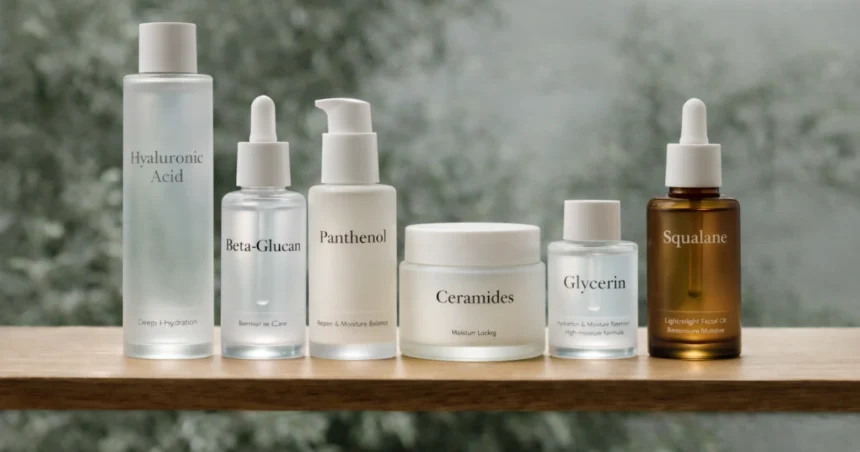
The ingredients covered in this guide, hyaluronic acid, glycerin, beta-glucan, ceramides, squalane, panthenol, and more, each play a role in building and maintaining healthy, hydrated skin. You don’t need all of them, but understanding what they do helps you choose wisely.
Start where you are. Maybe that’s adding a hydrating toner before your moisturizer. Maybe it’s finally trying that hyaluronic acid serum you’ve been curious about. Maybe it’s simply applying your current products to damp skin and noticing the difference.
Your skin is asking for hydration. Now you know how to give it.