I was a hyaluronic acid loyalist for years.
It was the first K-beauty ingredient I truly understood, and once I figured out how to use it correctly, I didn’t see any reason to look elsewhere for hydration.
Then came a particularly brutal California winter.
The Santa Ana winds were relentless, my office cranked the heat constantly, and no matter how carefully I applied my HA serum, damp skin, sealed with moisturizer, the whole routine, my face felt tight by mid-afternoon. Fine lines I’d never noticed were suddenly visible. Something wasn’t working.
A friend who’d lived in Colorado mentioned she’d switched from hyaluronic acid to beta-glucan and never looked back. I was skeptical. How could anything out-hydrate HA? But desperation makes you try things.
Within a week, my skin felt different. Calmer. More consistently hydrated throughout the day. That’s when I realized hydration isn’t one-size-fits-all, and sometimes the ingredient everyone talks about isn’t the one your skin actually needs.
What each ingredient does
Before comparing them, a quick recap.
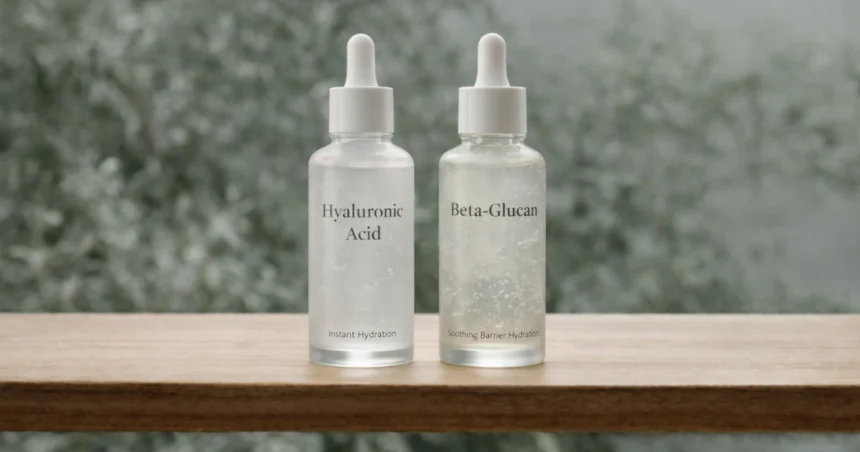
Hyaluronic acid is a humectant that occurs naturally in your skin. It attracts water from its environment and holds onto it, famously up to 1,000 times its weight in water. When applied topically, it draws moisture to your skin’s surface and creates that plump, bouncy texture. It comes in different molecular weights, affecting how deeply it penetrates.
Beta-glucan is a polysaccharide derived from sources like oats, mushrooms, or yeast. Like HA, it’s a humectant that attracts and holds water. But beta-glucan molecules are larger, meaning they work differently on skin. They form a protective film on the surface while delivering soothing, anti-inflammatory benefits.
Both ingredients hydrate. Both are gentle enough for sensitive skin. But they’re not interchangeable, understanding their differences helped me figure out which one my skin actually needed.
Hydration power compared
The marketing around hyaluronic acid focuses heavily on that “1,000 times its weight in water” claim. And it’s true, HA has impressive water-binding capacity. But holding water in a lab and holding water on your face are two different things.
Beta-glucan actually has similar water-holding abilities. Some studies suggest it may hold slightly more moisture, though research varies. What’s more relevant is how that hydration behaves throughout the day.
Hyaluronic acid provides intense, immediate hydration. Right after application, your skin looks plumper and feels softer. But because HA pulls moisture from wherever it can find it, results depend heavily on your environment. In humid conditions, it works beautifully, plenty of atmospheric moisture to attract. In dry conditions, HA can draw water from deeper skin layers, which is why some people feel drier after using it.
Beta-glucan provides steady, sustained hydration. The larger molecules create a film that reduces water loss throughout the day. It doesn’t give you that instant “wow” moment quite like HA does, but hydration lasts longer and feels more stable. My skin stayed comfortable from morning until night, without mid-afternoon tightness.
During that dry winter, HA was fighting a losing battle against the environment. Beta-glucan created a protective layer that kept moisture where it belonged.
Beyond hydration: additional benefits
Both ingredients bring something extra to your routine.
Hyaluronic acid’s bonus benefits:
- Plumping effect that temporarily reduces fine line appearance
- Helps other products absorb better when used as a first layer
- Supports wound healing
- Generally well-tolerated by reactive skin
Beta-glucan’s bonus benefits:
- Significant soothing and anti-inflammatory properties
- Helps calm redness and irritation
- Supports skin barrier repair
- Antioxidant properties protecting against environmental damage
- May help reduce wrinkle appearance over time
The soothing benefits won me over. I have mildly reactive skin, not severely sensitive, but prone to occasional redness when weather changes or stress hits. When I switched to beta-glucan, my skin didn’t just feel more hydrated. It looked calmer. Less pink. More even.
If you’re dealing with skin barrier issues or sensitivity alongside dehydration, beta-glucan pulls double duty in ways HA doesn’t quite match. For comprehensive barrier support, combining beta-glucan with ceramides creates an especially effective pairing.
Texture and feel on skin
One thing nobody told me before trying beta-glucan: the texture is different, and it takes getting used to.
Hyaluronic acid serums are typically very watery and lightweight. They absorb quickly, leave minimal residue, and layer beautifully under other products. That barely-there feel is part of why HA became so popular, it doesn’t disrupt your routine or feel heavy.
Beta-glucan products tend to be slightly thicker, with a more gel-like or viscous texture. They take longer to absorb and can leave a subtle film on skin. This isn’t bad, that film is part of how beta-glucan locks in moisture, but if you’re used to HA’s weightlessness, it’s an adjustment.
The first time I used beta-glucan serum, I wasn’t sure I liked it. It seemed almost sticky. But I gave it time to absorb (about 30-60 seconds), and by the time I applied moisturizer, my skin felt incredibly soft. Now I appreciate that slight tackiness because it means the product is forming a protective layer.
If texture concerns you, look for beta-glucan products combined with lighter hydrators, or use it as a later step when you’re ready for something richer.
Climate considerations
This is where the decision often becomes clear.
Humid climates favor hyaluronic acid. When there’s plenty of atmospheric moisture, HA does what it does best, pulls that environmental moisture to your skin. If you live somewhere tropical or humid, HA is probably your best friend.
Dry climates favor beta-glucan. When humidity is low, HA struggles to find moisture and may pull water from your skin instead. Beta-glucan doesn’t rely on environmental humidity the same way, it forms a barrier preventing moisture loss regardless of what’s happening outside. For desert climates, air-conditioned offices, heated homes, or dry winters, beta-glucan is often more reliable.
Living in California, I switch between them seasonally. During mild, occasionally humid summers, hyaluronic acid works well. Once fall hits and air dries out, I lean heavily on beta-glucan. My skin tells me what it needs, I just had to learn to listen.
Which should you choose?
After using both extensively, my recommendation depends on your situation.
Choose hyaluronic acid if:
- You live in a humid climate
- You want immediate plumping and that dewy, bouncy look
- You prefer very lightweight textures
- Your skin isn’t particularly sensitive
- You’re willing to commit to proper application (damp skin, sealing it in)
Choose beta-glucan if:
- You live in a dry climate or spend time in air conditioning/heating
- Your skin is sensitive, reactive, or prone to redness
- You want all-day hydration without reapplication
- You’re working on repairing your skin barrier
- You don’t mind a slightly richer texture
Choose both if: You want the best of both worlds. I currently use hyaluronic acid in my morning routine for that fresh, plump look under makeup, and beta-glucan at night for sustained hydration while I sleep.
Can you use both together?
Absolutely. Combining them might give better results than either alone.
When layering, I apply hyaluronic acid first (to damp skin, as always), then follow with beta-glucan. The HA draws moisture in, and beta-glucan seals it there while adding soothing benefits. It’s a one-two punch that works especially well in transitional seasons.
Some K-beauty products combine both ingredients in single formulas. Check ingredient lists, you’ll often see both sodium hyaluronate and beta-glucan together.
Pay attention to how your skin feels. Layering multiple hydrating products can sometimes feel heavy or cause pilling. Start with smaller amounts and adjust based on what your face absorbs comfortably.
Finding what works for your skin
I spent years thinking hyaluronic acid was the only hydrating ingredient that mattered because it was the only one anyone discussed. Discovering beta-glucan opened my eyes, the most popular ingredient isn’t always best for your specific situation.
Your skin is unique. Your climate matters. Your sensitivity level matters. The “best” hydrating ingredient is the one that actually works for your life and your face.
If hyaluronic acid has left your skin feeling tight or hasn’t delivered expected results, don’t give up on hydration entirely. Try beta-glucan. You might find, like I did, that the lesser-known option was what your skin needed all along.