The winter I destroyed my skin barrier is seared into my memory.
I’d gotten overly enthusiastic about chemical exfoliants. AHA one night, BHA the next, maybe a retinol thrown in for good measure. My skin had been looking dull, and I was convinced more actives would fix it. Instead, I ended up with skin that burned when I applied moisturizer. Everything stung, even water. My face was red, flaky, and so tight it felt like it might crack when I smiled.
A dermatologist friend took one look and said three words: “You need ceramides.” I didn’t really know what ceramides were at that point. They sounded vaguely scientific and boring, not the exciting active ingredients I’d been chasing. But I was desperate.
Within two weeks of switching to a ceramide-rich routine and cutting out all actives, my skin started feeling normal again. Within a month, it was better than it had been in years. That experience taught me something important: sometimes the most powerful skincare isn’t about adding exciting ingredients. It’s about giving your skin what it needs to function properly.
What are ceramides?
Ceramides are lipids, fats, essentially, that occur naturally in your skin. They’re a crucial component of your skin barrier, the outermost layer responsible for keeping moisture in and irritants out.
The easiest way to understand ceramides is the brick and mortar analogy. Imagine your skin barrier as a brick wall. The bricks are your skin cells. The mortar holding those bricks together? That’s where ceramides come in. Along with cholesterol and fatty acids, ceramides make up the lipid matrix filling spaces between skin cells, creating a cohesive, protective barrier.
When you have enough ceramides, your barrier is strong. Moisture stays in. Irritants, pollution, and bacteria stay out. Your skin looks plump, feels comfortable, and functions properly.
When ceramides are depleted, the mortar crumbles. Gaps form between skin cells. Water escapes. Irritants get in. This is when you experience that tight, dry, reactive feeling, more sensitive, more prone to redness, more easily irritated by products that never bothered you before.
Ceramides aren’t glamorous, but they’re foundational. Without them, nothing else works properly.
Why your skin loses ceramides
If ceramides are so important, why don’t we naturally have enough forever?
Unfortunately, ceramide production decreases as we age. By your thirties, you’re producing significantly fewer than in your teens. This decline continues, which is one reason mature skin tends to be drier and more prone to irritation.
But age isn’t the only factor:
Over-exfoliation strips ceramides faster than your body can replace them. This is exactly what happened to me. Acids, retinoids, and physical scrubs can all compromise your lipid barrier if overused.
Harsh cleansers remove ceramides along with dirt and makeup. That squeaky-clean feeling after washing? It might mean you’ve stripped away protective lipids. K-beauty’s emphasis on gentle, pH-balanced cleansers exists partly to protect ceramide levels.
Environmental factors like cold weather, low humidity, wind, and air conditioning all stress your barrier and deplete ceramides.
Hot water breaks down lipids in skin. Those long, hot showers that feel so good? They’re not doing your barrier any favors.
The good news: topical ceramides actually work. Unlike some ingredients that sound good but can’t really penetrate, ceramide-containing products can genuinely help replenish what you’ve lost.
Signs your skin needs more ceramides
Your skin usually tells you pretty clearly when ceramides are depleted.
Persistent dryness that moisturizer doesn’t fix. If you’re layering hydrating products but skin still feels dry, the issue might not be lack of hydration, it might be that your barrier can’t hold onto moisture.
Increased sensitivity. Products that never bothered you suddenly sting or cause redness. Your skin reacts to fragrance, certain actives, even things like vitamin C that used to be fine.
Tightness, especially after cleansing. That uncomfortable pulled feeling means skin is losing water rapidly, a sign of barrier dysfunction.
Flakiness and rough texture. When the mortar between skin cells breaks down, those cells don’t shed evenly.
Dullness. A healthy barrier reflects light evenly, giving skin that glow. A damaged barrier scatters light and looks flat.
Redness and inflammation. Without a strong barrier, skin constantly deals with low-grade irritation from things that shouldn’t be getting through.
If you’re nodding along to several of these, ceramides should probably be a priority. And if you’ve recently gone overboard with actives like I did, repairing your skin barrier with ceramides is step one.
Ceramide types: do the numbers matter?
When shopping for ceramide products, you’ll notice different types listed: ceramide NP, ceramide AP, ceramide EOP, or numbered versions like ceramide 1, ceramide 3. This gets confusing fast.
Your skin contains at least nine different ceramide types. The most common in skincare:
- Ceramide NP (Ceramide 3) Helps with hydration and barrier repair
- Ceramide AP (Ceramide 6-II) Supports skin smoothness and barrier function
- Ceramide EOP (Ceramide 1) Important for holding barrier structure together
Here’s what I’ve learned: don’t stress too much about specific types.
Having multiple ceramide types is theoretically better because it mimics your skin’s natural profile. But a product with just one or two types is still beneficial. Research shows topical ceramides help repair barriers regardless of which specific type you’re using.
What matters more is whether the product is well-formulated overall and includes supporting ingredients.
How to add ceramides to your routine
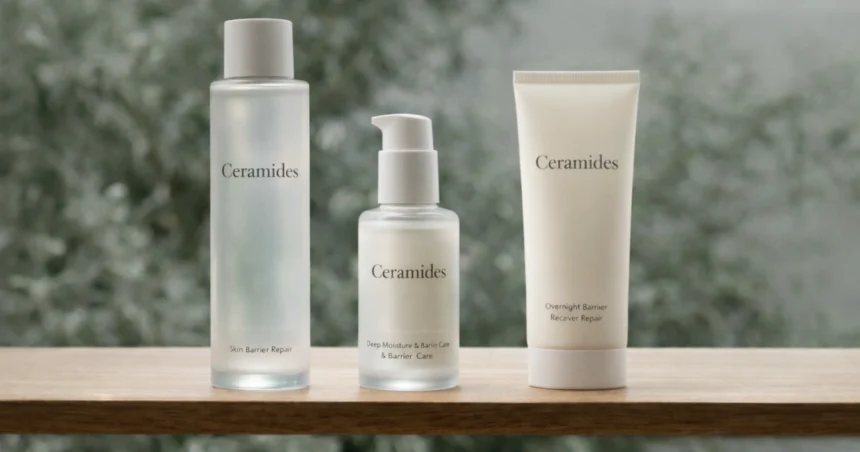
Ceramides show up in various K-beauty formats: toners, serums, moisturizers, sleeping masks, even cleansers. Format matters less than consistent use.
Moisturizers are the most common delivery system. Ceramides are lipids, and moisturizers already contain an oily base that helps ceramides penetrate effectively. A ceramide-rich moisturizer used morning and night is the easiest approach.
Toners and essences with ceramides add extra barrier support before moisturizer. These work well if you like multi-step hydrating routines.
Sleeping masks with ceramides provide intensive overnight repair. I love using these when my skin is particularly stressed.
When introducing ceramides, you don’t need to go overboard. One ceramide-focused product used consistently will make a difference. Apply after your watery layers, before heavier occlusives.
Ceramides + other ingredients
Ceramides work well alone but even better with certain partners:
Cholesterol and fatty acids. The lipid matrix isn’t just ceramides, it’s ceramides plus cholesterol plus fatty acids. Products including all three repair barriers more effectively.
Hyaluronic acid. HA attracts water; ceramides keep it there. Perfect partners.
Niacinamide. This multitasker helps skin produce its own ceramides. Using niacinamide alongside topical ceramides gives you a two-pronged approach.
Centella asiatica. If your barrier is damaged and inflamed, combining ceramides with centella addresses both structural repair and soothing.
What to avoid when compromised: While focusing on ceramide repair, pause retinoids, AHAs, BHAs, and other potentially irritating actives. Once your barrier is healthy, slowly reintroduce them.
The foundation everything else depends on
After my barrier disaster, I approached skincare differently. I used to chase the newest, most exciting actives, layering them aggressively and wondering why my skin wasn’t transforming.
Now I understand that none of those exciting ingredients work properly if your foundation is crumbling. Retinol on a damaged barrier just causes irritation. Vitamin C on compromised skin stings instead of brightening. Even hydrating ingredients can’t save you if your barrier can’t hold onto moisture.
Ceramides aren’t glamorous. They don’t promise overnight transformation. What they offer is something more important: a functioning foundation that allows everything else to work.
If your skin is struggling, reactive, dry, constantly irritated, stop looking for the next exciting active and look at your barrier instead. Ceramides might be exactly what you’re missing.