The first time I used hyaluronic acid, I did everything wrong.
I’d heard the hype about this magical ingredient that could hold 1,000 times its weight in water. My skin felt tight and looked dull, that papery texture no amount of moisturizer seemed to fix. So I ordered a hyaluronic acid serum, applied it to my bare face after showering, and waited for transformation.
Instead, my skin felt even tighter by noon. Drier, somehow.
I nearly gave up on hyaluronic acid entirely. Thank goodness I didn’t, because once I learned how to use it correctly, something Korean skincare taught me, it became one of the most reliable ingredients in my routine. The difference wasn’t the ingredient itself. It was understanding how it actually works.
What is hyaluronic acid?
Hyaluronic acid sounds intimidating, but it’s something your body produces naturally. It’s a sugar molecule that lives in your skin, connective tissues, and eyes. Its superpower is holding onto water, a single gram can hold up to six liters.
When we’re young, our skin is plump with hyaluronic acid. That bouncy, dewy quality babies have? Partly thanks to high HA levels. But as we age, natural production slows down. By our 40s and 50s, we’ve lost significant amounts, contributing to volume loss and fine lines.
Korean skincare embraced hyaluronic acid as a hydration hero early on. While Western products focused on heavy creams and oils, K-beauty recognized that flooding skin with water-binding ingredients, then sealing them in, created that coveted glass skin effect. Hyaluronic acid products are formulated in thin, layerable textures that absorb quickly without feeling greasy.
The appeal is straightforward: HA draws moisture to your skin and helps it stay there. Applied correctly, it leaves skin looking plumper, feeling softer, and those fine dehydration lines practically disappear.
Why molecular weight matters
When I first researched hyaluronic acid, terms like “low molecular weight” and “high molecular weight” confused me. Turns out, this is actually important for understanding how HA works.
Hyaluronic acid molecules come in different sizes, and size determines penetration depth.
High molecular weight HA has larger molecules that sit on skin’s surface. They can’t penetrate deeply, but they create a moisture-locking film that prevents water evaporation. This gives immediate plumping effects and protects your barrier. The downside: these benefits wash off.
Low molecular weight HA has smaller molecules that penetrate into the epidermis, providing deeper hydration with longer-lasting effects. However, very low molecular weight HA might cause inflammation in some people, research isn’t conclusive, but worth knowing if you have reactive skin.
Multi-weight formulas combine both to deliver deep hydration plus surface moisture-locking. Many Korean hyaluronic acid products use this approach, and in my experience, they work better than single-weight formulas.
You’ll also see sodium hyaluronate vs hyaluronic acid on labels, it’s the salt form of HA with smaller molecular size that penetrates more easily. Most products actually use sodium hyaluronate rather than pure hyaluronic acid.
How to apply hyaluronic acid correctly
Remember how I did everything wrong initially? Here’s what I’ve learned since.
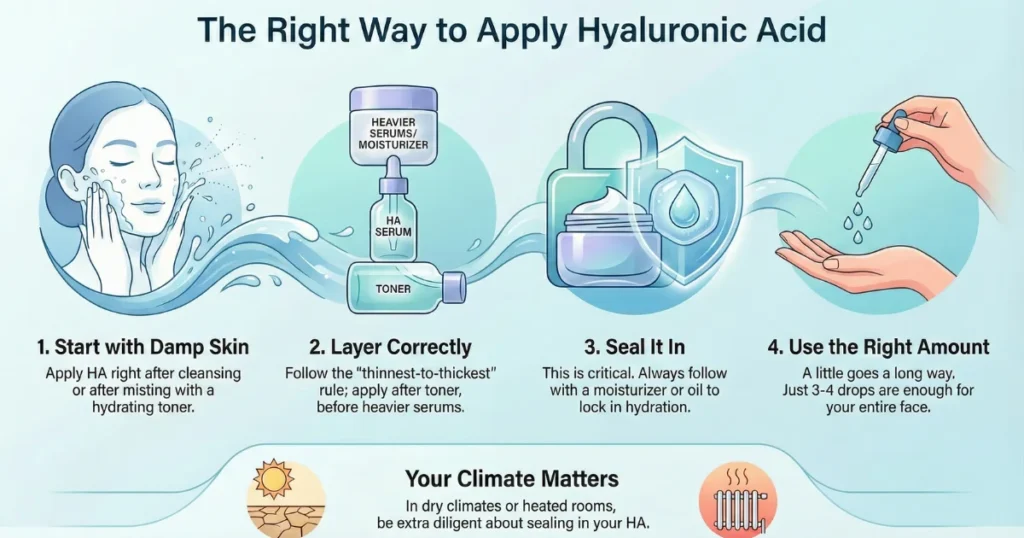
Apply to damp skin. This is the most important rule. Hyaluronic acid is a humectant, it pulls moisture from its environment. Apply it to dry skin in a dry climate, and it can pull moisture from deeper skin layers instead of from the air. Always apply HA to slightly damp skin, right after cleansing or after misting with hydrating toner.
Layer it correctly. In Korean skincare layering, hyaluronic acid products go after toner and before heavier serums and moisturizers. Follow the thinnest-to-thickest rule, and most HA serums are quite watery.
Seal it in. This is what I missed completely at first. Hyaluronic acid attracts water, but you need something on top to prevent evaporation. Follow with moisturizer or facial oil to lock in hydration. Skipping this step is usually why people feel HA makes their skin drier.
Use the right amount. A little goes a long way. I use about 3-4 drops for my whole face, patted gently with fingertips. You don’t need to drench your skin, just enough for a thin, even layer.
Consider your climate. In very dry environments, desert climates, air-conditioned offices, heated winter homes, be extra careful about sealing in your HA. In humid environments, hyaluronic acid works like magic because there’s plenty of atmospheric moisture to attract.
Why HA might make your skin feel drier
I get messages about this constantly: “I tried hyaluronic acid and it made my skin worse.” Almost always, the issue is one of these problems.
You’re applying to dry skin. HA needs moisture to work with. Apply while skin is still damp, or mist your face first.
You’re not sealing it in. Without an occlusive layer on top, the water HA attracted will evaporate, taking some of your skin’s natural moisture with it. Always follow with something that creates a barrier.
Your environment is too dry. In very low humidity, even properly applied HA can struggle. Consider other humectants like beta-glucan, which some find works better in arid conditions.
The formula doesn’t agree with your skin. Some people find very low molecular weight HA causes sensitivity or congestion. Try switching to medium or high molecular weight formulas instead.
Once I fixed my technique, hyaluronic acid became genuinely transformative. The tight, uncomfortable feeling disappeared, and I started seeing that plump, hydrated look I’d been chasing.
Who benefits most from hyaluronic acid
The beauty of hyaluronic acid is that it works for almost everyone. It’s lightweight, non-irritating for most skin types, and addresses universal concerns.
Dehydrated skin benefits most obviously. If your skin feels tight, looks dull, or shows fine lines that disappear when you pinch the skin, HA will probably make noticeable difference.
Oily skin can absolutely use hyaluronic acid. Oily skin can still be dehydrated, they’re not the same thing, and lightweight HA serums provide moisture without adding oil or heaviness.
Dry skin loves hyaluronic acid but typically needs additional support from richer moisturizers. HA alone won’t be enough for truly dry skin types.
Aging skin benefits from HA’s plumping effects. As natural hyaluronic acid decreases, adding it topically helps offset some of that loss.
Sensitive skin usually tolerates hyaluronic acid well. Start with simple formulas without additional actives.
What to layer with hyaluronic acid
Building an effective routine around hyaluronic acid is about creating complementary layers, this is where K-beauty philosophy shines.
Before HA: A hydrating toner creates the perfect damp base. Pat on watery toner, then apply HA serum while skin is still slightly wet.
With HA: Some people layer multiple hydrating products together. I’ve written about snail mucin vs hyaluronic acid, I use both. Snail mucin adds healing benefits that complement HA’s hydration.
After HA: Seal in moisture with lightweight gel moisturizer for daytime, richer cream for nighttime, facial oil like squalane, or sleeping pack for intensive overnight hydration.
Great pairings: Niacinamide for brightening, vitamin C for antioxidant protection, centella asiatica for soothing, and ceramides for barrier repair.
Hyaluronic acid is only one part of the equation when it comes to hydration. For a full list of humectants, emollients, and occlusives, check out complete guide to hydrating ingredients in Korean skincare.
Making hyaluronic acid work for you
Looking back at my initial frustration, I’m grateful I didn’t write off hyaluronic acid entirely. The problem was never the ingredient, it was my technique.
These days, HA is a consistent part of my routine. Not because it’s trendy, but because I’ve seen what it does when applied correctly. That plump, dewy texture. Fine lines around my eyes looking softer. Makeup sitting better on hydrated skin.
If you’ve tried HA before and felt disappointed, give it another chance with proper technique: damp skin, thin layers, seal it in. If you’re new to hyaluronic acid, start simple, a straightforward serum with good moisturizer on top.
Your skin might just thank you for it.