The first time someone told me to use a toner, I bought the wrong thing entirely.
- Korean toners aren’t what you think
- What makes a toner hydrating?
- Top hydrating ingredients to look for
- Ingredients to avoid in hydrating toners
- Hydrating vs exfoliating toners: knowing the difference
- Matching toner ingredients to your skin type
- The 7-skin method: is it worth it?
- Finding your perfect hydrating toner
Growing up with combination skin in the 90s and 2000s, toner meant one thing: that astringent liquid you swiped across your face with a cotton pad after cleansing. It stung a little. It smelled like alcohol. It was supposed to remove “residue” and tighten your pores. My skin felt squeaky and tight afterward, which I interpreted as clean.
When I discovered Korean skincare and people kept recommending toners, I assumed they meant the same thing. I almost skipped the category entirely based on my terrible experiences.
Then I tried an actual K-beauty hydrating toner.
No sting. No alcohol smell. No tight, stripped feeling. Instead, my skin felt soft and plump, like it had just taken a long drink of water. The product was watery and light, nothing like the harsh astringents I remembered. I patted it into damp skin and watched it absorb almost instantly.
That moment rewired my understanding of what toner could be. Korean toners aren’t about stripping or tightening, they’re about flooding your skin with hydration as the very first step after cleansing. And the ingredients inside make all the difference.
Korean toners aren’t what you think
If your only experience with toner is Western astringents, K-beauty toners will surprise you. The philosophy is completely different.
Western toners (traditional) were designed to remove leftover cleanser residue, “balance” skin pH, and tighten pores. Many contained alcohol, witch hazel, or other astringent ingredients. They were about taking away, removing oil, removing residue, removing whatever your cleanser missed.
Korean toners are designed to add. They’re the first layer of hydration in your routine, applied immediately after cleansing to prep your skin for everything that follows. Instead of stripping, they nourish. Instead of tightening, they plump.
The texture is different too. Most K-beauty toners are thin and watery, almost like water with something extra dissolved in it. They’re meant to be patted into skin with your hands, not swiped with a cotton pad (which wastes product and can tug at skin).
This hydrating-first approach is foundational to Korean skincare philosophy. Damp, hydrated skin absorbs subsequent products better. Starting with a hydrating toner means your serums, essences, and moisturizers can actually penetrate and do their jobs.
Once I understood this distinction, toner went from a product I avoided to one I can’t imagine skipping.
What makes a toner hydrating?
Not all K-beauty toners are purely hydrating, some contain exfoliating acids, some focus on soothing, some target specific concerns like acne or aging. But hydrating toners share common characteristics.
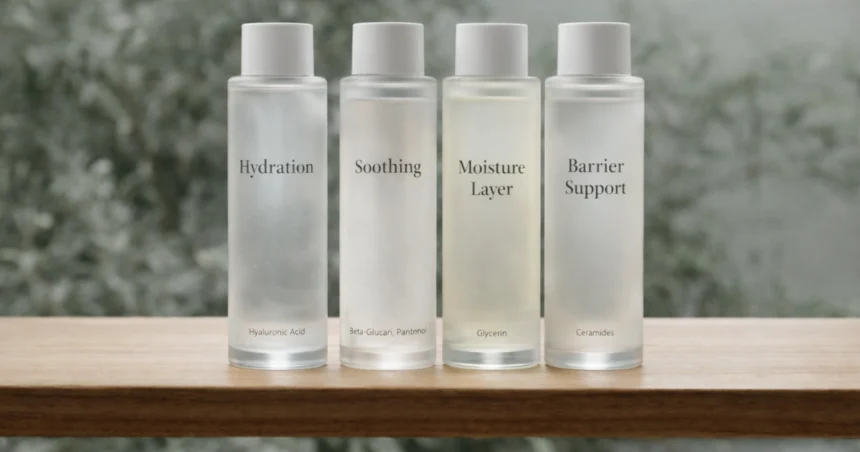
They prioritize humectants. The ingredient list features water-attracting molecules like hyaluronic acid, glycerin, beta-glucan, and panthenol. These pull moisture to your skin and help it stay there.
They skip harsh alcohols. Denatured alcohol (alcohol denat, SD alcohol) appears rarely if at all. These alcohols evaporate quickly and can be drying, the opposite of what a hydrating toner should do.
They have a watery texture. Hydrating toners are thin and fluid, designed to absorb quickly and layer well. Thick, creamy products aren’t toners; they belong later in your routine.
They’re pH-balanced. Your skin’s natural pH is slightly acidic (around 4.5-5.5). Good hydrating toners work within this range rather than disrupting it.
They feel comfortable. No stinging, no tightness, no burning. If a toner makes your skin feel worse immediately after application, it’s not doing its job.
When shopping for hydrating toners, flip the bottle over and read the ingredient list. What you find there tells you more than any marketing claim on the front.
Top hydrating ingredients to look for
These are the ingredients I scan for when choosing a hydrating toner. Finding several of them together usually indicates a well-formulated product.
Hyaluronic acid / Sodium hyaluronate The most famous humectant for good reason. Hyaluronic acid holds up to 1,000 times its weight in water, plumping skin and smoothing fine dehydration lines. In toner form, it absorbs quickly and creates an ideal base for layering. Look for sodium hyaluronate, it’s the salt form with smaller molecules that penetrate more easily.
Glycerin The underrated workhorse of hydrating toners. Glycerin is affordable, effective, and stable. It attracts moisture without any fuss. You’ll find it in almost every well-formulated hydrating toner, often in the top five ingredients.
Beta-glucan My personal favorite, especially for dry climates. Beta-glucan hydrates while forming a protective film that prevents moisture loss. It’s also soothing, which makes it perfect for reactive skin. If hyaluronic acid hasn’t worked well for you, look for toners featuring beta-glucan instead.
Panthenol (Provitamin B5) Panthenol attracts moisture while calming and supporting skin healing. It adds a softening quality to toners and helps compromised skin recover. Finding panthenol alongside other humectants usually indicates a thoughtfully formulated product.
Centella asiatica / Madecassoside While primarily a soothing ingredient, centella adds hydrating and barrier-supporting benefits to toners. If your skin is both dehydrated and reactive, toners with centella offer dual benefits.
Aloe vera A natural humectant with soothing properties. Aloe adds lightweight hydration without heaviness, making it popular in toners for oily or combination skin.
Trehalose A sugar-based humectant that protects skin cells from environmental stress while hydrating. Less famous than hyaluronic acid but increasingly appreciated in K-beauty formulations.
Propolis Adds hydration plus healing and antibacterial benefits. Propolis-containing toners work well for skin that’s dehydrated and breakout-prone.
Snail mucin Yes, really. Snail secretion filtrate is hydrating, healing, and smoothing. Toners with snail mucin deliver multiple benefits in one watery layer.
The best hydrating toners combine several of these ingredients. A formula with glycerin, hyaluronic acid, and panthenol together will typically outperform one with just a single humectant.
Ingredients to avoid in hydrating toners
Some ingredients work against the goal of hydration. Watch for these when reading labels.
Denatured alcohol (Alcohol denat, SD alcohol, Ethanol) These alcohols evaporate quickly, potentially taking moisture with them. Small amounts low on an ingredient list are usually fine, but avoid toners where alcohol appears in the first five or six ingredients.
Note: Not all alcohols are bad. Fatty alcohols like cetyl alcohol and cetearyl alcohol are actually moisturizing and fine to use.
Witch hazel (Hamamelis) A traditional astringent that can be drying for some skin types. Some people tolerate it fine, but if hydration is your goal, witch hazel isn’t helping.
Strong fragrance Heavy fragrance doesn’t affect hydration directly but can irritate sensitive or compromised skin. If your skin is dehydrated, it’s often more reactive than usual, fragrance-free or lightly-scented options may be gentler.
High concentrations of exfoliating acids AHA and BHA toners have their place, but they’re not hydrating toners. If you see glycolic acid, salicylic acid, or lactic acid high on the ingredient list, you’re looking at an exfoliating product, not a hydrating one. Don’t confuse the categories.
Hydrating vs exfoliating toners: knowing the difference
This distinction tripped me up when I was starting out. Both products are called “toner” but serve completely different purposes.
Hydrating toners add moisture. They’re gentle enough for daily use, often twice daily. They make skin feel comfortable and plump. Use them as the first step after cleansing, every time you cleanse.
Exfoliating toners contain acids (AHAs, BHAs, PHAs) that dissolve dead skin cells. They improve texture and clarity but can be drying or irritating if overused. Most people use them a few times per week, not daily, and definitely not twice daily.
You can use both types in your routine, but not interchangeably. They’re different tools for different jobs.
On days when I use an exfoliating toner, I often follow it with a hydrating toner before continuing my routine. The exfoliant does its job, then the hydrating toner replenishes moisture and preps skin for serums.
Matching toner ingredients to your skin type
While hydrating toners work for most people, certain ingredients suit certain skin types better than others.
Dry skin: Look for toners with multiple humectants plus ingredients that prevent moisture loss. Hyaluronic acid, glycerin, beta-glucan, and ceramides together create a hydration powerhouse. Richer, more viscous toners (sometimes called “toner essences”) can work well for truly dry skin.
Oily skin: Lightweight, watery toners that absorb instantly without residue. Hyaluronic acid and glycerin in thin formulas work beautifully. Avoid anything that feels heavy or leaves a film. Niacinamide-containing toners add oil control alongside hydration.
Combination skin: This is my skin type, and I’ve had best results with versatile middle-ground toners, hydrating enough for my dry cheeks without overwhelming my oily T-zone. Hyaluronic acid plus lightweight soothing ingredients like aloe or centella tend to work well.
Sensitive skin: Gentle formulas with soothing ingredients alongside humectants. Beta-glucan, panthenol, centella, and aloe calm while hydrating. Fragrance-free is usually safer. Avoid toners with long ingredient lists full of potential irritants.
Dehydrated skin (any type): Dehydration needs humectants, period. Focus on toners where hyaluronic acid, glycerin, or beta-glucan appear high on the ingredient list. Multiple layers of toner (the 7-skin method) can help severely dehydrated skin recover faster.
Acne-prone skin: Non-comedogenic hydrating ingredients won’t clog pores. Hyaluronic acid, glycerin, snail mucin, and propolis are all safe for breakout-prone skin. Some people find that proper hydration actually reduces breakouts by preventing the dehydration-triggered oil overproduction that can cause congestion.
The 7-skin method: is it worth it?
You’ve probably heard of the 7-skin method, applying seven layers of toner for intense hydration. It sounds excessive, but there’s logic behind it.
The idea is that multiple thin layers penetrate better than one thick layer. Instead of drowning your face in one application of toner, you apply a small amount, let it absorb, apply another layer, let that absorb, and repeat up to seven times.
Do you need seven layers? Probably not. I rarely go past three or four. But the principle is sound: layering hydrating products builds moisture more effectively than applying one heavy product.
When to try multiple toner layers:
- Your skin is severely dehydrated
- You’re in an extremely dry climate
- Your skin just looks parched and needs intensive care
- You want to skip serum and get extra hydration from toner instead
When one layer is enough:
- Your skin is reasonably hydrated and just needs maintenance
- You’re using multiple other hydrating products after toner
- You’re short on time (most mornings in my house)
- Your skin feels satisfied after one application
Listen to your skin. Some days it wants more; some days it’s fine with less. The 7-skin method is a tool, not a requirement.
Finding your perfect hydrating toner
Toner was the K-beauty category that surprised me most. I went from avoiding it entirely to considering it essential, all because I learned what hydrating toners actually are and what they can do.
The right ingredients make all the difference. Humectants like hyaluronic acid, glycerin, and beta-glucan transform toner from an afterthought into the foundation of your entire hydrating routine. Reading ingredient lists, not marketing claims, tells you whether a toner will actually hydrate or just sit on your shelf disappointing you.
If you haven’t experienced a good K-beauty hydrating toner yet, you’re missing the first step that makes everything else work better. Find one with ingredients that match your skin’s needs, pat it into damp skin after cleansing, and feel the difference.
Your skin is thirsty. A hydrating toner is its first drink.