Three years ago, I stood in my bathroom surrounded by products that promised to transform my skin. Prescription retinoids, harsh cleansers, aggressive treatments. My face was red, irritated, and still breaking out despite following every rule Western dermatology offered.
- Starting as a complete beginner
- Understanding the 10-step framework
- Morning vs night routine differences
- Product layering and order
- Simplifying without sacrificing results
- Realistic time expectations
- Common mistakes that sabotage results
- The minimalist 5-step approach
- Recognizing when your routine is working
- Adapting your routine over time
- FAQ
Then I discovered Korean skincare, and everything changed.
Korean skincare isn’t about using more products or following complicated rituals. It’s about treating your skin differently with gentleness, hydration, and intention. The philosophy prioritizes supporting your skin rather than attacking it, building your moisture barrier rather than stripping it away.
This guide covers everything you need to know about building a Korean skincare routine that actually works. Whether you’re a complete beginner feeling overwhelmed by unfamiliar product categories, or someone looking to refine an existing routine, you’ll find practical guidance grounded in real experience. I’ve spent five years testing products, making mistakes, and learning what actually delivers results for busy people with real lives.
Your skin isn’t broken. It might just need something different than what you’ve been giving it.
Starting as a complete beginner
The biggest barrier to Korean skincare isn’t lack of interest it’s overwhelm. Ten-step routines, unfamiliar product categories, countless brands with names you can’t pronounce. Most beginners close their browser tabs and never return because the learning curve seems impossibly steep.
Here’s what took me too long to understand: you don’t need to master everything before you start. You don’t need ten products or even five. You need a simple beginning that lets you experience the difference gentle, hydration focused care makes for your skin.
When I finally committed to K-beauty, I started with just two products a low pH cleanser and a basic moisturizer. Those two products changed my skin more in six weeks than years of complicated Western routines ever had. Starting simple isn’t settling for less. It’s building a foundation you can expand from with confidence.
The beginner approach that works best follows a specific pattern. First, establish core products: gentle cleanser, hydrating toner, moisturizer suited to your skin type, and daily sunscreen. Use these consistently for several weeks, paying attention to how your skin responds. Only after this baseline feels comfortable should you consider adding anything else.
This patience serves multiple purposes. It prevents overwhelming product overload that causes many people to quit. It lets you actually understand what each product does for your skin. And it establishes habits you can maintain long term rather than elaborate routines you’ll abandon within a month.
The two-week rule becomes essential: wait at least two weeks between introducing any new product. This timeline lets your skin fully adjust and reveals clear causeand effect relationships.
For complete guidance on your first steps, including specific product recommendations and week-by-week expectations, read our detailed guide on how to start a Korean skincare routine as a complete beginner.
Understanding the 10-step framework
The 10-step Korean skincare routine has achieved almost mythical status in the beauty world. Some treat it as sacred gospel requiring strict adherence. Others dismiss it as excessive marketing designed to sell more products. Neither perspective captures what the framework actually represents.
The 10-step routine isn’t a prescription you must follow daily without deviation. It’s a comprehensive map showing every possible product category and where each fits in logical sequence. Think of it like a restaurant menu just because ten sections exist doesn’t mean you order from all of them. You choose what you need based on your skin that day.
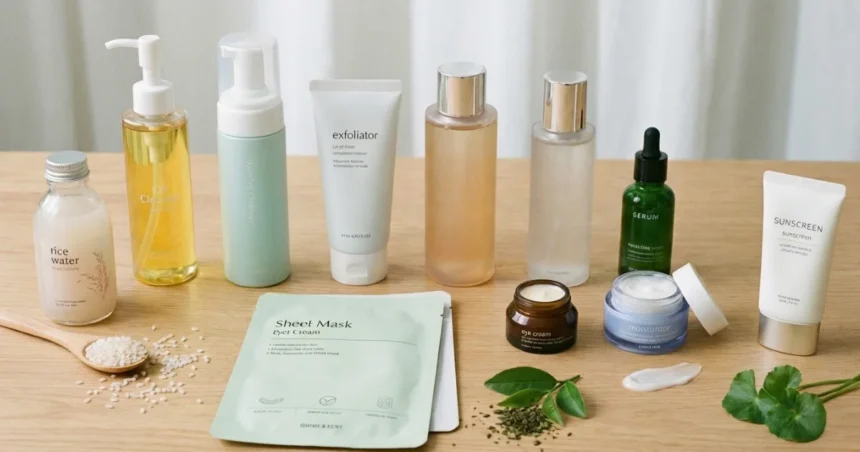
The ten steps, in order: oil cleanser, waterbased cleanser, exfoliator, toner, essence, serum or ampoule, sheet mask, eye cream, moisturizer, and sunscreen in the morning or sleeping mask at night. Each category serves a specific purpose, from removing impurities to delivering targeted treatments to sealing everything in.
Understanding this framework matters because it provides structure for decision making. When you encounter a new product, you know exactly where it fits in your routine. When your skin needs something specific, you know which category addresses that need. The framework creates order from potential chaos.
Most people never use all ten steps in a single routine I certainly don’t. My typical morning involves four steps. Evening routines might expand to six or seven depending on my skin’s needs and available time. Some categories, like sheet masks and eye cream, appear in my routine only occasionally rather than daily.
The framework’s real value lies in flexibility. It shows you all available options while making clear that options aren’t obligations. You can build a complete, effective routine using just four categories. You can expand to eight during periods when your skin needs extra attention. The structure accommodates both approaches equally well.
What matters isn’t hitting a specific step count. What matters is understanding why each category exists and choosing the ones that serve your particular skin.
Morning vs night routine differences
Morning and evening routines serve fundamentally different purposes, and understanding this distinction transforms how you approach your skincare. These aren’t just the same steps repeated twice daily they’re strategically designed responses to what your skin faces at different times.
Morning routines focus on defense and preparation. During daylight hours, your skin battles environmental stressors constantly: UV radiation, pollution particles, temperature fluctuations, air conditioning pulling moisture from your face. Your morning products should protect against these aggressors while remaining lightweight enough to layer comfortably under makeup if you wear it.
The morning core stays consistent for most people: gentle cleanse or water rinse, hydrating toner, lightweight moisturizer, and sunscreen without exception. These four steps take roughly five to seven minutes and prepare your skin to face whatever the day brings. Products should absorb quickly and never feel heavy or greasy.
Evening routines shift toward repair and treatment. Your skin enters regeneration mode during sleep, with cell turnover peaking and natural healing processes running at full capacity. Nighttime becomes your opportunity to cleanse thoroughly, deliver treatment ingredients, and provide nourishment that supports overnight recovery.
Double cleansing becomes essential at night to remove sunscreen, makeup, pollution, and accumulated sebum from the day. Active ingredients like retinol and chemical exfoliants belong exclusively to evening routines some break down in sunlight, others increase photosensitivity, and all work better when your skin isn’t fighting environmental stressors simultaneously.
Product textures can run richer in the evening since you’re not concerned about makeup application or daytime comfort. Heavier moisturizers, facial oils, and sleeping masks all belong to nighttime rituals. These occlusive products seal in previous layers and provide sustained nourishment throughout sleep hours.
The time investment differs too. Morning routines prioritize efficiency. Evening routines allow for more elaborate care when energy and schedule permit. Both serve essential but distinct functions in your skin’s overall health.
Product layering and order
Product order isn’t arbitrary preference or skincare tradition it’s physics. Apply products in the wrong sequence, and you’re literally blocking ingredients from reaching your skin. Understanding layering principles ensures every product you invest in actually delivers its intended benefits rather than sitting uselessly on the surface.
The foundational rule is elegantly simple: thinnest to thickest consistency. Watery products go first because they absorb quickly and penetrate effectively. Thicker products follow because they absorb more slowly and create barriers that would block anything applied afterward. Violating this principle means your lightweight essences and serums can’t penetrate through heavier creams already sitting on your skin.
This translates to a predictable sequence after cleansing. Toner goes first it’s typically the most watery product in any routine. Essence follows, slightly more substantial but still lightweight. Serums and ampoules come next, delivering concentrated active ingredients. Eye cream applies before moisturizer since the delicate eye area benefits from targeted treatment before heavier products seal everything in. Moisturizer creates the final treatment layer. Sunscreen or sleeping mask finishes the routine as the most occlusive step.
Texture provides your primary guidance when product placement feels uncertain. If you can’t decide whether one product goes before or after another, observe which absorbs faster when applied to your hand. The quicker absorbing product belongs earlier in your sequence.
Wait times between layers matter too, though less rigidly than some sources suggest. Generally, wait until each product feels absorbed not completely dry, but no longer wet or slippery before applying the next layer. This typically takes thirty seconds to one minute. Active treatments like retinol and vitamin C benefit from slightly longer absorption times before you layer moisturizer over them.
Common layering mistakes include applying facial oils too early, putting essence before toner, and layering over sunscreen that hasn’t fully absorbed. Each error reduces the effectiveness of products you’ve invested money and time in using.
Simplifying without sacrificing results
There’s a persistent myth in skincare that more products automatically equal better results. My own experience proved the opposite. When I was forced to simplify my elaborate twelve-step routine after becoming a mom, my skin actually improved. Less irritation, more balance, consistent health despite dramatically reduced time and product count.
This counterintuitive outcome makes sense once you understand the mechanisms. Layering too many active ingredients overwhelms skin, causing irritation, sensitivity, and barrier damage. Using numerous products simultaneously makes it impossible to identify what’s actually helping versus hurting. And complicated routines are difficult to maintain consistently sporadic elaborate care loses to simple daily care every single time.
Simplification doesn’t mean abandoning K-beauty principles. It means identifying which steps deliver the most impact for your particular skin and focusing your energy there. The essentials remain non-negotiable: proper cleansing, adequate hydration, moisture protection, and sun defense. Everything beyond these fundamentals becomes optional rather than required.
The process of simplifying requires honest assessment. Which products have you genuinely seen results from? Which are you using simply because you bought them or because someone recommended them online? Which redundant products are doing essentially the same thing? Eliminating redundancy often reveals you can achieve identical results with half the product count.
Many people discover their skin thrives with strategic minimalism. Four or five well-chosen products used consistently outperform twelve products used sporadically. The reduced complexity also makes routines sustainable through busy periods, travel, illness, and life chaos that would derail elaborate rituals.
Simplification creates clarity too. With fewer products, you understand exactly what each one contributes. You notice when something isn’t working. You can adjust strategically rather than guessing which of your many products might be causing problems.
The permission to stay simple matters psychologically. Korean skincare should enhance your life, not burden it. If extensive routines feel like obligations rather than self-care, simplifying transforms your entire relationship with skincare.
Realistic time expectations
The elaborate hour long skincare sessions many people imagine when they hear “Korean skincare” simply don’t exist in real practice. This misconception prevents countless people from trying K-beauty at all, assuming they don’t have the lifestyle to support such intensive rituals. The reality is far more accessible than the myth suggests.
Most of your skincare time isn’t active product application it’s waiting for absorption between layers. When I actually timed myself, each step takes maybe fifteen to thirty seconds of hands on work. The waiting adds another thirty seconds to a minute per product. A five step routine with reasonable absorption time totals roughly six to eight minutes. Even thorough routines using more steps rarely exceed twenty minutes.
My actual morning routine takes seven minutes, including time spent brushing teeth while products absorb. Evening routines run about twelve minutes when I’m being thorough, sometimes less when energy is low. These aren’t special abbreviated versions they’re normal, complete routines that deliver real results without consuming your schedule.
Understanding which steps consume time helps you plan realistically. Double cleansing takes the longest at about three minutes for both steps done properly. Sheet masks add fifteen to twenty minutes but aren’t daily requirements. Multi layer toning techniques extend hydration time by a few minutes when your skin needs extra moisture. Quick steps like serum and eye cream each take under a minute.
Strategic multitasking makes routines feel even shorter. Apply toner, then brush teeth while it absorbs. Pat in serum, then check your phone or chat with family. The waiting time doesn’t require standing motionless at your mirror it integrates naturally into existing morning and evening activities.
The time investment scales with your circumstances too. Minimal nights happen in four minutes when life gets chaotic. Elaborate weekly treatment sessions might stretch to thirty minutes when you have the luxury of extended self-care. Both extremes fit within the K-beauty framework because the approach adapts to your reality.
Common mistakes that sabotage results
Even with the best intentions and quality products, certain mistakes can undermine your entire routine. I made every possible error during my early K-beauty journey mistakes that nearly made me abandon Korean skincare entirely before understanding what was going wrong.
The most damaging mistake involves overwhelming your skin with too many active ingredients simultaneously. Excitement about K-beauty’s powerful ingredients vitamin C, retinol, AHAs, BHAs, niacinamide leads many people to layer multiple actives in the same routine. The result is barrier damage, increased sensitivity, and skin that looks worse than before you started. Your skin can only tolerate so much, and respecting those limits matters more than accessing every beneficial ingredient at once.
Impatience creates equally significant problems. Skincare works on biological timelines that cannot be rushed. Expecting dramatic transformation after one week leads to constant product switching, which means nothing ever has time to actually work. The people who see real results commit to consistent routines for months, not days.
Wrong product order wastes your investment entirely. Applying thick products before thin ones creates barriers blocking absorption of everything following. That expensive serum sitting on top of your moisturizer isn’t delivering benefits it’s just sitting there uselessly until you wash it off.
Over-cleansing represents another common trap, especially for people transitioning from Western skincare mentality. The tight, squeaky clean feeling after washing isn’t cleanliness it’s barrier damage. Gentle cleansing that leaves skin comfortable preserves the protective layers your skin needs to function properly.
Skipping sunscreen might be the most costly mistake of all, measured in long term skin health. UV exposure counteracts every brightening serum, anti aging treatment, and hydrating product you use. Without daily protection, you’re pouring effort into a leaking bucket.
Copying someone else’s exact routine ignores the reality that your skin is unique. What works perfectly for your favorite influencer might cause problems for you due to different skin types, climates, and concerns.
The minimalist 5-step approach
The 5-step routine represents the sweet spot between too little and too much. It covers every essential function your skin needs without redundancy or overwhelm thorough cleansing, proper hydration, targeted treatment, moisture protection, and sun defense. Nothing is filler. Every product earns its place.
This approach emerged from necessity in my own life. After my daughter was born, elaborate routines became impossible. I discovered that five strategic steps done consistently delivered better results than ten sporadic steps ever had. The constraint forced clarity about what actually mattered versus what just felt productive.
The five steps break down simply. Cleansing removes impurities double cleanse at night, gentle single cleanse or water rinse in the morning. Hydrating toner preps skin and delivers the first moisture layer. One targeted serum addresses your primary concern, whether that’s hydration, brightening, acne, or aging. Moisturizer seals everything in and protects your barrier. Sunscreen finishes every morning routine without exception.
This framework takes seven to eight minutes in the morning and about ten minutes at night. That’s manageable for virtually any lifestyle single parents, demanding careers, chronic health challenges, anyone who cannot dedicate extensive time to skincare but still wants meaningful results.
The single serum limitation forces valuable prioritization. Instead of layering multiple treatments hoping they’ll all work, you identify your most important skin concern and address it directly. This focused approach often proves more effective than scattered efforts across many products competing for absorption.
Five steps also creates sustainable habits. You can maintain this routine when exhausted, traveling, or navigating life chaos. Consistency over months builds results that elaborate but sporadic routines never achieve. The routine becomes automatic rather than requiring daily decisions and motivation.
The minimalist approach doesn’t preclude occasional additions. Weekly sheet masks, periodic sleeping masks, seasonal adjustments these extras enhance the foundation without becoming daily obligations. The five step structure remains stable while allowing flexibility for special circumstances.
Recognizing when your routine is working
One of the most frustrating aspects of skincare is uncertainty about whether your efforts are paying off. You stare at your face daily, searching for transformation, often seeing nothing different. This leads many people to abandon effective routines prematurely, convinced nothing is working when progress was actually happening all along.
The problem lies in daily observation itself. Skin changes so gradually that looking in the mirror every morning provides almost no useful feedback. It’s like watching a child grow you don’t notice height changes day to day, but relatives who visit quarterly see dramatic differences. Your skin works identically, changing too slowly for immediate perception but transforming significantly over weeks and months.
Progress follows predictable timelines once you understand what to expect. The first signs appear within one to two weeks not dramatic visual changes but sensory differences. Skin feels more comfortable throughout the day, less tight after cleansing, more balanced overall. These comfort improvements signal your routine is moving in the right direction even before visible transformation appears.
Medium-term progress emerges between weeks three and six. Texture starts smoothing under your fingers. Skin becomes less reactive to minor irritations. Overall tone looks more even without being dramatically different. Fewer new breakouts appear, and existing ones heal faster.
Long-term transformation the kind people associate with K-beauty success requires months of consistent care. Fading hyperpigmentation, minimized pore appearance, genuine glow that looks lit from within. These results build gradually through patient, sustained effort rather than appearing overnight from any single product.
Tracking progress effectively requires strategies beyond daily mirror checks. Monthly comparison photos in consistent lighting reveal changes your perception misses entirely. Skin journals documenting how your face feels catch patterns over time. Observations from people who don’t see you daily often notice improvements you’ve become blind to through constant exposure.
Understanding realistic timelines and progress markers prevents the discouragement that derails many skincare journeys before results have time to materialize.
Adapting your routine over time
The routine that cleared my cystic acne at twenty-five doesn’t work for my skin at thirty-two. The products I swore by before pregnancy caused breakouts during it. The lightweight layers perfect for Austin summers leave me parched when winter arrives. Skin isn’t static it changes constantly, and your routine must evolve alongside it.
Understanding why skin changes helps you anticipate and respond to shifts rather than being caught off guard. Age brings gradual changes in oil production, cell turnover rate, and moisture retention. Hormones create more dramatic swings throughout menstrual cycles, pregnancy, and menopause. Seasons and climate affect skin predictably but significantly. Stress, sleep, diet, and health all leave their marks on your face.
Learning to recognize when your skin needs something different is one of the most valuable skills you can develop. Sudden increased oiliness when skin was previously balanced might signal dehydration rather than excess oil production. New dryness or flakiness indicates your moisture barrier needs additional support. Breakouts appearing in new patterns suggest something internal or external has shifted. Products that worked beautifully stopping their effectiveness means your skin’s needs have changed while your routine stayed static.
Seasonal adjustments represent the most predictable changes you’ll make. Summer typically calls for lighter textures, reduced product layers, and increased cleansing attention. Winter demands richer moisturizers, additional hydration layers, and extra barrier protection against dry indoor heating. Transition seasons require gradual shifts rather than sudden overhauls.
Life stage adjustments run deeper than seasonal swaps. Pregnancy, postpartum recovery, periods of intense stress, and the natural changes of aging all require fundamental routine restructuring rather than simple product substitutions.
The goal isn’t finding one perfect routine to follow forever. It’s building a skincare approach flexible enough to serve your skin through all its changes. Responsiveness rather than rigidity keeps skin healthy across years and decades.
FAQ
How long does it take to see results from a Korean skincare routine? Initial comfort improvements skin feeling less tight, more balanced typically appear within one to two weeks. Visible texture and tone improvements emerge between weeks three and six. Significant transformation like fading dark spots or minimized pores requires three to six months of consistent care. Patience is essential because skin renewal follows biological timelines that cannot be rushed.
Do I really need to do all 10 steps? No. The 10 step framework shows every possible product category, not a daily requirement. Most people use four to six steps regularly and see excellent results. Focus on the essentials cleansing, hydrating, moisturizing, and sun protection and add other steps only when your skin genuinely needs them.
Can I use Korean skincare with my current Western products? Absolutely. K-beauty integrates well with Western products. The key is following proper layering order (thinnest to thickest consistency) and avoiding too many active ingredients in the same routine regardless of where products originate. Many people build hybrid routines combining their favorite products from both approaches.
Is Korean skincare good for sensitive skin? Korean skincare often works exceptionally well for sensitive skin because the philosophy emphasizes gentle formulations and barrier support rather than aggressive treatments. Look for products featuring soothing ingredients like centella asiatica, snail mucin, and ceramides. Introduce new products slowly and choose fragrance free options when possible.
How much should I budget for a Korean skincare routine? Effective K-beauty exists at every price point. A complete basic routine can cost under fifty dollars, with many excellent products priced between eight and fifteen dollars each. You don’t need expensive products to see results consistency and choosing appropriate products for your skin type matter far more than price tags.
What’s the difference between essence and serum? Essences are lightweight, watery products that deliver hydration and prep skin to absorb following products. Serums are slightly thicker with higher concentrations of active ingredients targeting specific concerns. Essences go before serums in your routine. Many people use both, though either can be skipped depending on your skin’s needs.
Should I use the same routine morning and night? Morning and evening routines should differ because they serve different purposes. Mornings focus on lightweight protection and sun defense. Evenings focus on thorough cleansing, treatment ingredients, and repair support. Some products like toner and moisturizer appear in both routines, but the overall approach and product weight should shift between morning and night.
Building a Korean skincare routine isn’t about following rigid rules or achieving a perfect step count. It’s about understanding your skin’s needs and responding with intention, consistency, and kindness.
The journey starts simple gentle cleanser, hydrating toner, moisturizer, sunscreen. From there, you learn your skin’s language through patient observation. You discover which products deliver results and which just feel productive. You build habits sustainable enough to maintain through busy seasons of life.
My own skin transformed not because I found magic products but because I changed my approach entirely. I stopped fighting my skin and started supporting it. I traded aggressive treatments for gentle consistency. I learned that patience and simplicity often outperform complexity and impatience.
Your skin is ready for the same transformation. Whether you’re battling acne like I was, struggling with dryness, or simply wanting to maintain healthy skin for years to come, Korean skincare offers a framework that adapts to your unique needs and circumstances.
Start with our beginner guide if you’re new to K-beauty. Explore specific topics that address your concerns. Most importantly, give yourself permission to begin simply and build gradually.
Ready to start your Korean skincare journey? Begin with how to start a Korean skincare routine as a complete beginner and discover what gentle, hydration-focused care can do for your skin.