I was comparing two hyaluronic acid serums online, trying to decide which one to buy, when I noticed something that sent me down a rabbit hole.
One product listed “hyaluronic acid” as its star ingredient. The other listed “sodium hyaluronate.” Both claimed to deliver intense hydration. Both had similar textures and price points. Both had great reviews.
Were these the same thing with different names? Or were they actually different ingredients? Did it matter which one I chose?
I spent way too long researching this. Probably more time than necessary, honestly. But I learned something useful, and now I can save you the rabbit hole.
What’s the actual difference?
Hyaluronic acid and sodium hyaluronate are closely related but not identical. The simplest explanation:
Hyaluronic acid (HA) is the pure, original form of the molecule. It’s a large sugar molecule (glycosaminoglycan) that occurs naturally in your skin, joints, and eyes. In its pure state, hyaluronic acid has a relatively large molecular size and a slightly acidic pH.
Sodium hyaluronate is the sodium salt form of hyaluronic acid. It’s created by removing the hydrogen from hyaluronic acid and replacing it with sodium. This might sound like a minor chemical tweak, but it changes how the ingredient behaves.
When you add sodium to hyaluronic acid, the resulting molecule is smaller and more stable. Sodium hyaluronate dissolves in water more easily and has a more neutral pH than pure hyaluronic acid.
Think of it like table salt versus pure sodium, related, but not interchangeable. Or sparkling water versus still water. Same basic substance, different properties.
Which penetrates skin better?
This is where the difference actually matters for skincare.
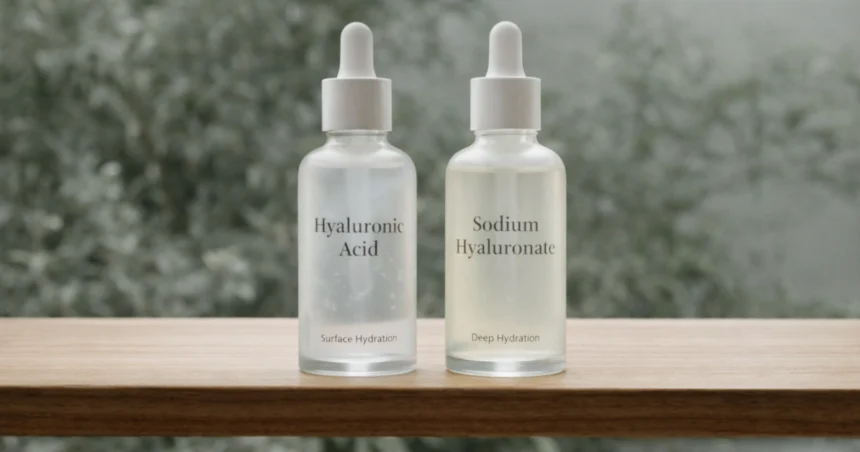
Sodium hyaluronate has smaller molecules than pure hyaluronic acid. Smaller molecules can penetrate the outer layer of your skin more easily, potentially delivering hydration to deeper levels.
Pure hyaluronic acid, with its larger molecular size, tends to sit on the skin’s surface. This isn’t necessarily bad, surface hydration creates a moisture-locking film and gives you that immediate plumping effect. But it doesn’t penetrate as deeply.
Sodium hyaluronate offers a bit of both: some molecules penetrate while others remain on the surface. The result is hydration at multiple levels of your skin.
This is one reason hyaluronic acid in Korean skincare often appears as sodium hyaluronate in the actual ingredient list. K-beauty formulators prioritize absorption and efficacy, and sodium hyaluronate delivers.
Stability matters too. Sodium hyaluronate is more stable than pure hyaluronic acid, meaning it’s less likely to degrade in your product over time. This is partly why most skincare products use sodium hyaluronate even when they advertise “hyaluronic acid” on the front label.
Does it matter which one your product uses?
Here’s the honest answer: for most people, probably not.
Both hyaluronic acid and sodium hyaluronate attract and hold water. Both hydrate your skin. Both are well-tolerated by virtually all skin types. The differences exist, but they’re not dramatic enough for most people to notice in everyday use.
If you’re comparing two products and one uses hyaluronic acid while the other uses sodium hyaluronate, I wouldn’t make that the deciding factor. Other aspects of the formula, concentration, supporting ingredients, texture, price, probably matter more.
That said, if you want the theoretically “better” form, sodium hyaluronate has a slight edge due to its smaller molecular size and better stability. But I’ve used products with both and honestly can’t tell a difference in how my skin feels.
What matters more is using hyaluronic acid (in either form) correctly. Applying it to damp skin, sealing it with moisturizer, being consistent, these factors affect your results far more than which specific form of HA your product contains.
Hydrolyzed hyaluronic acid: a third option
While researching, you might also encounter “hydrolyzed hyaluronic acid” on ingredient lists. This is yet another variation worth understanding.
Hydrolyzed hyaluronic acid is hyaluronic acid that’s been broken down into even smaller fragments through a process called hydrolysis. These tiny fragments can penetrate deeper than both regular HA and sodium hyaluronate.
The trade-off? Some of the water-holding capacity is lost when you break the molecules into smaller pieces. Hydrolyzed HA penetrates better but may not attract and hold quite as much water per molecule.
Many modern K-beauty products combine multiple forms, regular HA for surface hydration, sodium hyaluronate for mid-level penetration, and hydrolyzed HA for deeper delivery. This multi-weight approach attempts to hydrate at every level of your skin.
When you see a product advertising “multi-molecular hyaluronic acid” or “5 types of HA,” this is usually what they mean. Different sizes working together.
Reading ingredient labels: what to look for
Now that you know the differences, here’s how to decode what you’re seeing on product packaging.
On the front of the bottle: Brands almost always say “hyaluronic acid” in their marketing regardless of what’s actually in the formula. It’s the term consumers recognize. Don’t assume the front label tells you which form is inside.
In the ingredient list: This is where you’ll find the truth. Look for:
- Hyaluronic acid: Pure form, larger molecules
- Sodium hyaluronate: Salt form, smaller molecules (most common)
- Hydrolyzed hyaluronic acid: Broken down into tiny fragments
- Sodium hyaluronate crosspolymer: A modified form that creates a film on skin
- Sodium acetylated hyaluronate: A form with enhanced moisture retention
Many products contain multiple forms. That’s generally a good thing, it means you’re getting hydration at different depths.
Concentration and position: Ingredients are listed in descending order of concentration. If hyaluronic acid or sodium hyaluronate appears in the first half of a longish ingredient list, there’s a meaningful amount present. If it’s buried near the bottom, it’s probably included in trace amounts, more for marketing than efficacy.
Unfortunately, most brands don’t disclose exact HA percentages. Research suggests concentrations of 0.1% to 2% are effective for most people. Higher isn’t always better, very high concentrations can sometimes feel sticky or cause irritation.
What I actually pay attention to
After all that research, here’s what I’ve concluded for my own routine:
I don’t stress about whether a product uses hyaluronic acid or sodium hyaluronate. Both work. I’ve loved products with each form and noticed no meaningful difference in hydration.
What I do pay attention to:
Where HA appears on the ingredient list. Higher up generally means more of it. I want it in the top third of the list, ideally.
Whether there are multiple molecular weights. Products advertising multi-weight HA tend to perform slightly better in my experience, though this might be confirmation bias.
Supporting ingredients. HA works best when paired with other humectants like glycerin and beta-glucan, plus occlusives to seal everything in. For how humectants fit into the bigger picture, see my guide to hydrating ingredients in Korean skincare.
How I use it. Application technique matters more than formulation details. Damp skin, proper layering, sealing with moisturizer, these make more difference than which form of HA I’m using.
The bottom line
Sodium hyaluronate and hyaluronic acid are different but closely related. Sodium hyaluronate is slightly smaller and penetrates slightly better. Most skincare products use sodium hyaluronate even when they market themselves as “hyaluronic acid” products.
For practical purposes, this distinction rarely matters. Both forms hydrate effectively. Both are gentle and well-tolerated. Both deserve a place in your routine if hydration is a goal.
Don’t let ingredient label confusion stop you from using hyaluronic acid, in whichever form your favorite product contains. Focus on using it correctly, and your skin will thank you regardless of which version you choose.